Every spring, property owners here in Maine cede our rights over to the blackfly population. With their serrated jaws and overwhelming numbers, they swarm by the hundreds, drawn by breath and body heat. I’ve seen them drive even the most determined souls back into the safety of home.
When my four sons were all small and yearning for the great outdoors after a long winter, I would pile them into the car and drive to a playground in town, just to escape the bloody, itchy, swollen mess the black flies inflict, aided by their buggy-brand of saliva which is both an anticoagulant (so the blood flows freely!) and an anesthetic (so you don’t realize they’re feasting on you!).
Apparently, early settlers here in Maine welcomed spring in spite of the blackflies, because it meant an end to their diet of unrefrigerated bear meat. The first dandelion greens were the perfect medicine for the bleeding gums and boredom that accompanied the winter menu. The local lore is that black flies disappear after the first thunderstorm of the season, and, while I’ve never verified that scientifically, I can attest that they are still in full swarm mode right now as I weed and water the garden at the end of May!

Come Spring Lane lies to the left on one of my regular walking routes. Here in Maine, “Come Spring” serves as an adverb, an answer to the question “when”:
“Come spring, we’ll plant a garden.”
“Come spring, the flowers will bloom.”
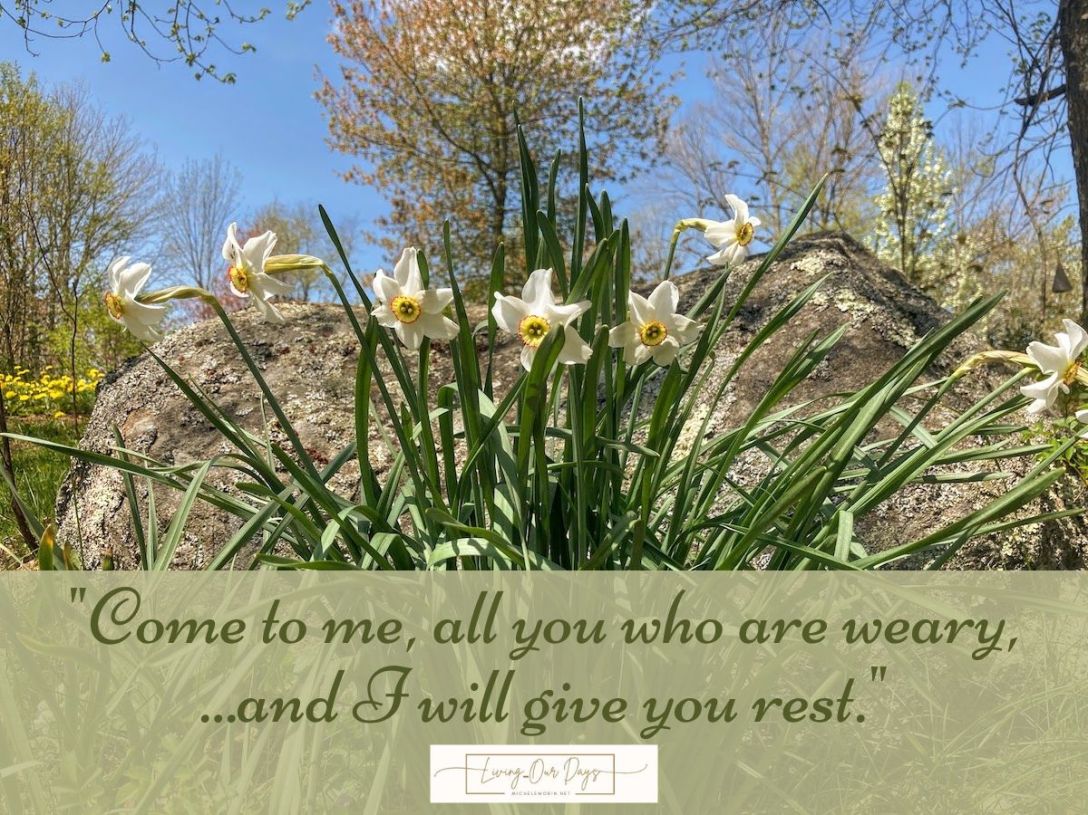
My orientation to time is always toward the future, but never more so than at the end of a long winter and the beginning of a spring season that seems stuck in neutral. And so, today, when the calendar verifies that it’s almost summer, for me, “Come, Spring” is a prayer.
Black fly season, a Maine spring stuck in neutral, and bookish talk about #AllWhoAreWeary–an author’s struggle with depression and hope for renewal.
Tweet
And Now, Let’s Talk Books…


Lately, when I ask friends, “How are you doing,” I notice a pattern in their responses. Everyone seems tired, worn out, and weighed down by life. Sarah J. Hauser offers a reasonable cause for all this weariness: Maybe we’re carrying loads we were never designed to bear.
Written honestly from the author’s struggle with depression, All Who Are Weary offers the hope of renewal for the inner self. Jesus invites the believer to take his easy yoke, and this is not an invitation to improved performance or perfection, but rather an expression of mercy and love.
Hauser makes the excellent observation that believers may need professional help getting their minds and emotions to a healthy place before they are equipped to engage in a spiritual battle. Given this, how exactly do we begin to unload our burdens at Jesus’s feet? Chapter by chapter, the book chips away with a gospel chisel at the reader’s understanding of the burdens we carry, demonstrating what it looks like to live without the weight of condemnation, worry, insecurity, comparison, perfectionism, and despair.
Laying aside these weights, we find ourselves free to follow Jesus unencumbered and to serve him as we serve others. This is the path to rest.
Holding You in the Light,

In #AllWhoAreWeary Sarah Hauser chips away with a gospel chisel at our understanding of the burdens we carry, demonstrating what it looks like to bring our heavy load to Jesus and take the light burden he gives instead @MoodyPublishers
Tweet
Many thanks to Moody Publishers for providing a copy of this book to facilitate my review, which is, of course, offered freely and with honesty.
Did You Know that I Also Publish a Monthly Newsletter?
Every month I send a newsletter with biblical encouragement straight to my subscribers’ email inboxes. Frequently, I share free resources, and the newsletter is where everything lands first. I’m committed to the truth that women can become confident followers of God and students of his Word, and it’s my goal to help you along that path.
To add this free resource to your pursuit of biblical literacy, simply CLICK HERE. There, on Substack’s website, you’ll find a prompt that looks just like this image for Living Our Days with Michele Morin. Over on that site, simply enter your email and then click on the purple “SUBSCRIBE” button.
You’ll receive a welcome letter to confirm your subscription and monthly encouragement in your email inbox.

I am a participant in the Amazon Services LLC Associates Program, an advertising program designed to provide a means for sites to earn advertising fees. If you should decide to purchase any of the books or products I’ve shared, simply click on the image, and you’ll be taken directly to the seller. If you decide to buy, I’ll receive a few pennies at no extra cost to you.


 Living Our Days
Blackflies sound horrible! We deal with mosquitos and gnats here, but not in swarms like that. I have wondered at times why such pests had to come along on the ark and survive the flood. 🙂 I hope that thunderstorm comes soon and drives them out.
LikeLike
I have to keep telling myself that they must be a food source for some beautiful creature somewhere…🤣
LikeLiked by 1 person
Oh yes, we hiked a beach trail around Scarborough last year and I was eaten alive— without realizing it until we were well on our way home.
LikeLike
Sneaky little things, aren’t they?!
And they really own the land until they somehow go away eventually!
LikeLike
Those blackflies sound terrible! Hope a thunderstorm comes to clear them away soon! Thanks for sharing the phrase “come spring” and about “All Who Are Weary” – it’s on my TBR list, and based on your review, might get bumped up in the pecking order. : )
LikeLike
I look forward to hearing your reaction to the book!
LikeLike
Michele, I’m much the same way in my orientation to time. I’m so much more intentional in my observations in the spring and summer. I am more able to be still, pause & reflect.
Visiting you today from Grace At Home #52&53.
LikeLike
Hmmm… great observation about your seasonal habits. I have never noticed that myself but I want to pay attention!
LikeLiked by 1 person
loved reading about life up in the Maine woods, friend! my goodness, you do have a way with words. i never tire reading them and hearing your heart and wisdom and humor.
LikeLike
It’s a gift to me that you find all three in my words! Sometimes I need an outside perspective to know exactly how things are coming through here. You too?
LikeLike
Wow, Michele. I had no idea about the ways black flies’ saliva is an anti-coagulant AND an anesthetic. That explains a lot. Years ago, we took the boys the the Great Salt Lake in Utah. I had never seen so many flies before. They flew upward with each footfall on the shore.
I guess our perspective determines how we view things. Spring can offer flies or flourishing after the winter. I appreciated your post!
LikeLike
Spring always lands like a great gift–and it’s such a metaphor for the warmth and light of God’s provision!
LikeLike
Where have I been all my life to not hear of black flies till now? I’m surprised the early settlers didn’t abandon Maine, claiming it unfit for human habitation!
LikeLike
I have said many times that if it had been up to me to settle the wilderness here, it would STILL be wilderness. Everything I have read about the early settlers could almost frighten me to death!
LikeLiked by 1 person
I’m right there with you, Michele!
LikeLike
When you commented that your next post was about black flies, the scourge of Maine springs, I had to laugh. I did have the month wrong though how I ever could forget when they arrive is a mystery. I hope their voracious appetites are easing up and that Come Spring you’ll have that sweet renewal of rest and hope in the new season! blessings to you, Michele.
LikeLike
I’m looking forward to the end of black flies, but don’t want to rush the summer!
LikeLike
Michele, that annual black fly invasion sounds like a biblical plague! How long do they usually hang around? I think Sarah Hauser is right about weariness caused by loads we were never meant to bear. I wonder how many of those loads are delivered via that little rectangle that seems to be constantly affixed to people’s hands? Happy Summer, friend!
LikeLike
Your right! It does feel plague-ish! And I was encouraged by Sarah’s book to assess the things in my life that feel “load-ish” as compared with those that bring simple joy. I’ll be taking some time off this summer to charge those batteries.
LikeLike