Why is it that the big questions float to the surface unexpectedly?
It’s not when I’m sitting alert with open journal and quiet mind, but rather when I’m pushing a shopping cart or a vacuum cleaner hose; when I’m mixing cookie dough or scrubbing a pot, that a face comes to mind or a news report hooks my ear:
A powerful hurricane flattens a poor village
The simmering soup in Washington D.C. bubbles over onto the stove–again
Another local suicide
Another big name succumbs to a moral crash and burn
What does all this mean, and how are we to make sense of a world where evil seems to be sitting in the driver’s seat most of the time?
If you’ve spent any time at all turning pages in a Bible, you know we’re not the first to ask these big questions, and we certainly will not be the last. The psalms overflow with tears and bristle with question marks while Job hangs onto his faith by a thin thread. Not many of us look to Habakkuk, the obscure minor prophet, for much of anything, never mind insights on the problem of evil, but this year’s trip through the Bible has had me reading and studying there once again.
Set against a backdrop of moral decline and impending exile, Habakkuk opens with a raging question, flung into the silence of God:
O LORD, how long shall I cry,
Habakkuk 1:2
And you will not hear?
Even cry out to you, ‘Violence!’
And you will not save.”
God speaks into the silence in verse 5 with the kind of verse we love to put on T-shirts and couch pillows:
Look among the nations and watch–
Be utterly astounded!
For I will work a work in your days
Which you would not believe,
though it were told you.”
To Habakkuk’s “Do you see us?” God delivers a decisive, “Yes,” but instead of reassurance, instead of promises of restoration and rescue that echo His words to Moses or Gideon, God promises judgment at the hands of a heathen nation! In fact, it seems pretty clear that God has been at work behind the scenes preparing the Chaldeans (Babylonians) for their big moment in redemptive history.
The ways of God are inscrutable, “past finding out” according to Paul, and yet we get a glimpse of his nature here as he employs an evil empire in the ultimate rescue of his people through the fire of exile and the devastating loss of their homeland. It’s clear that God wanted Israel’s heart with such a ferocious love that he would go to any length to secure it. Unchanged and unchanging, he pursues you and me today, and he will stop at nothing to get our mind’s attention and our heart’s affection.
C.S. Lewis, writing from the cruel jaws of grief, concluded that his loss was not likely to make him disbelieve in God, but rather, “to believe such dreadful things about him.” In a world that offers pandemics, racial tension, and political vitriol as evidence, we must cling to what we know from scripture about God’s goodness and his sovereignty in order to think biblically about the presence of evil alongside the reality of a holy and loving God.
In a world of pandemics, racial tension, and political vitriol, we must cling to truth about God’s goodness and his sovereignty in order to think biblically about the presence of evil alongside the reality of a holy and loving God.
Tweet
The purpose of evil in my own world (and in yours) may depend entirely upon our response to it:
Do we repent and allow it to turn us toward God and his word as King Josiah did?
Do we embrace evil since it seems certain to win no matter what we do?
Do we try to ignore it, distracting ourselves with mindless entertainment or trivial pursuits?
God’s goodness and his sovereignty are at work even when we are unable to track his methods, and judgment may be running on a parallel track with a rescue plan that truly is “utterly astounding.” He does hear and he longs for us to bring our questions and our confusion to him rather than allowing the big questions to come between us.
What questions have you been bringing to God on the regular?
Are you allowing the tension of all we don’t understand about God and his ways to come between you and God–or to bring you to your knees in worship?
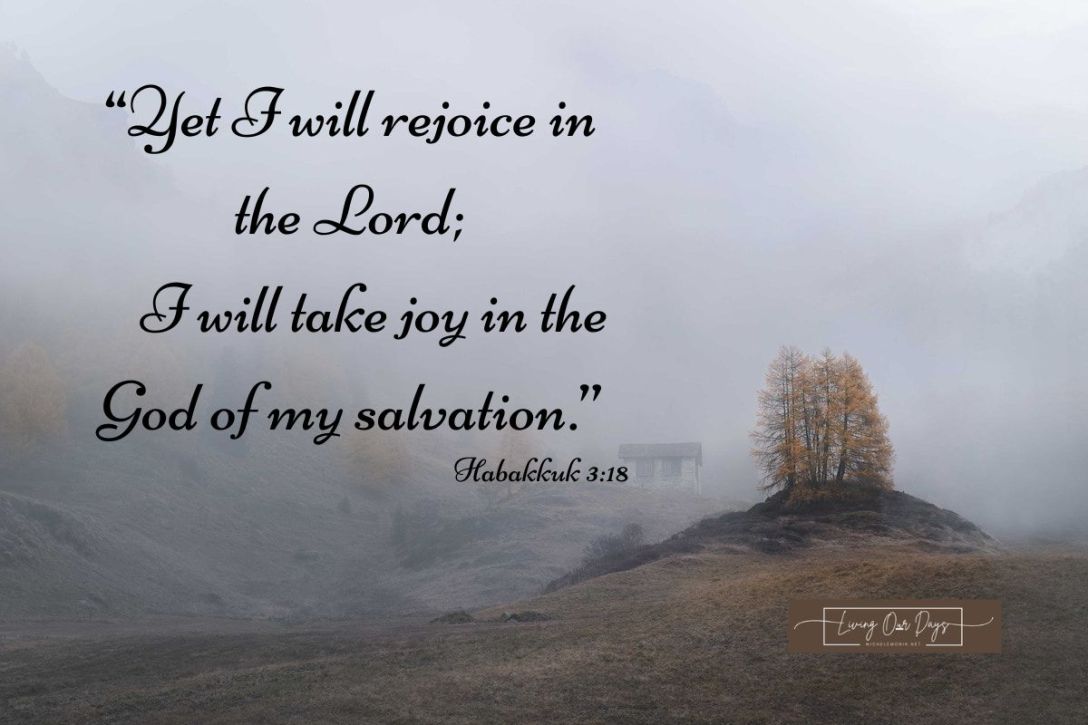
“Look among the nations and watch–Be utterly astounded! For I will work a work in your days which you would not believe, though it were told you” (Habakkuk 1:5).
Tweet
And Now Let’s Talk Books…


How ironic that the book hardly anyone has read answers the question everyone asks: Why does God allow injustice? In his succinct Old Testament book, the prophet Habakkuk wails the question and prays for answers as he learns to live by faith.
This is the theme of Lydia Brownback’s seventh study in the Flourish Series, an approach to Bible study that emphasizes big-picture thinking about God’s overarching narrative in the scriptures while employing deep study of the book of Habakkuk.
A wealth of visual resources allows readers to confidently pronounce complex terminology and place Habakkuk’s prophetic ministry historically and geographically. Set in an era of violence and injustice, Habakkuk’s “How long?” finds its answer in a foreshadowing of gospel hope and his portrayal of a promise-keeping God who is mighty to save.
God keeps his promises, and, therefore, the hope of deliverance is well-founded. From Habakkuk, we learn the grace of waiting in hope, certain that God is at work either to deliver us from trouble or to transform us in the midst of trouble.
Holding You in the Light,

“God sometimes answers our prayers by allowing things to become much worse before they become better.” ~@LydiaBrownback #Habakkuk #LearningtoLivebyFaith via @crossway
Tweet
And an Additional Resource on Habakkuk…


Habakkuk: Remembering God’s Faithfulness When He Seems Silent by Dannah Gresh uses the breadth of scripture to interpret the prophet’s message and his times in a six-week study that incorporates a deep reading of the text with prayer prompts that encourage meditation on the message. Gresh defines meditation as “what happens when studying and praying collide,” and shares six habits of living by faith that emerge naturally from Habakkuk’s prophetic writing. For readers who long to remember the faithfulness of God in the past as a confidence booster for dealing with hard times in the present or fears about the future, the little book of Habakkuk will be a surprising source of inspiration, and Dannah Gresh a skilled and sympathetic guide.
Did You Know that I Also Publish a Monthly Newsletter?
Every month I send a newsletter with biblical encouragement straight to my subscribers’ email inboxes. Frequently, I share free resources, and the newsletter is where everything lands first. I’m committed to the truth that women can become confident followers of God and students of his Word, and it’s my goal to help you along that path.
To add this free resource to your pursuit of biblical literacy, simply CLICK HERE. There, on Substack’s website, you’ll find a prompt that looks just like this image for Living Our Days with Michele Morin. Over on that site, simply enter your email and then click on the purple “SUBSCRIBE” button.
You’ll receive a welcome letter to confirm your subscription and monthly encouragement in your email inbox.

Photo by Samuel Ferrara on Unsplash
I am a participant in the Amazon Services LLC Associates Program, an advertising program designed to provide a means for sites to earn advertising fees. If you should decide to purchase any of the books or products I’ve shared, simply click on the image, and you’ll be taken directly to the seller. If you decide to buy, I’ll receive a few pennies at no extra cost to you.
Many thanks to Crossway for providing a copy of this book to facilitate my review, which is, of course, offered freely and with honesty.


 Living Our Days
Thank you.
LikeLike
Thank YOU for reading!
LikeLike
The question I have been asking lately is, “How did we even end up here?” To some degree, I know the answer but the question sure has come out of my mouth more times than I would like. You have shared from my absolute favorite book of the Bible. I love Habakkuk – for the many lessons, hope, and comfort it has brought to me personally over the years. I so appreciate the book recommendations and am going to check them out. Perhaps it is time for me to return to Habakkuk. Thank you for sharing these!
LikeLike
So interesting that Habakkuk is your favorite! I’m percolating right now on the idea of covering Habakkuk with my women’s Sunday school class. I don’t want to scare anyone away with the idea, but it’s a short book stuffed with so much beautiful and hopeful truth for times when YOUR question is absolutely right! “How DID we end up here?”
LikeLike
Amen to every word, Michele. The fact that God is both good and sovereign has been foundational for me throughout my adult life.
LikeLike
And it becomes a more precious truth to me every year!
LikeLike
Habakkuk is one of my favorite books, and I have enjoyed others of Lydia Brownback’s studies, so I will have to look up her book.
I was thinking recently while reading through the arrest and trial of Jesus that it must have looked to the disciples like everything was going wrong. Yet everything was working out God’s plan of redemption. It’s the same with Esther and Habakkuk and so many others. Truly God’s ways are not ours. Knowing that doesn’t always make life easier, when in my humanness I wish God would do things a different way. But reminding myself that He sees the big picture and knows what He is doing encourages me to trust.
(BTW, for some reason, WordPress’s new comment box isn’t allowing me to separate my response into different paragraphs. Oh well–at least it’s letting me comment. 🙂 )
LikeLike
Well, that’s weird–it didn’t separate into different paragraphs in the comment box, but did when the comment published. Strange! 🙂
LikeLiked by 1 person
😵💫🤷♀️I appreciate your perseverance!
LikeLiked by 1 person
The mysterious ways of WP!
And I appreciate your observation. What looks like a catastrophe to me, the end of everything, may actually be a beginning.
LikeLiked by 1 person
Great post, Michele.1 And so true that God wants us to bring those big questions to Him, not letting them separate us from God.
LikeLike
Yes, they actually become the basis for a new and deeper relationship!
LikeLike
It comforts me to see the great biblical men and women of faith asking the same questions that we wrestle with. One thing that has struck me in Scripture is how God brings evil out into the open to defeat it and display His glory. Watching and waiting.
LikeLiked by 1 person
Yes, anyone who feels disqualified by doubt or questioning needs to read the biblical record to be comforted. The questions have all been asked and the doubts are all in print!
LikeLike
These are hard books to page through and difficult questions to wrestle with, Michele. I appreciate what you said about these thoughts coming to us at the oddest times. I’ve found that to be true, as well. God is always speaking to us and I sometimes hear Him best when I’m simply going through the day.
LikeLike
This really helps me to appreciate the opportunities to work with my hands, to be outside and away from the distractions.
LikeLike
It is reassuring to read that the men (and women) of God from eons ago struggled with the same questions we grapple with today. When the answers don’t come I have to remind myself: With perfect wisdom, God has provided all the answers for us he’s deemed necessary. For the doubts and questions, I must exercise my trust. A Babbie Mason song from several decades ago comes to mind: “When you don’t understand / When don’t see his plan / When you can’t trace his hand / Trust his heart.” Surely that’s what Habakkuk did, indicated by what he wrote: “The righteous person will live by his faithfulness” (2:4b).
LikeLike
Great point, Nancy! We look back in faith that God was with us even though we may not have been aware of him at the time.
LikeLiked by 1 person
The older I get in my walk with my Lord, the more prayer becomes a “pray without ceasing” journey.
Evil will get worse in these last days for the enemy knows he’s running out of time.
And God has already told us that it will before Jesus’ return but it doesn’t stop us from bringing it all to Him in prayer.
Blessings, Jennifer
LikeLike
My friend Susan says, “Never say amen!” Continuous prayer!
LikeLiked by 1 person
I love when your words take me deeper into study. Going to have another look at Habakkuk more deeply. Very wise words and I love how you broke this down it’s really easy to understand.
Thanks so much for sharing this with Sweet Tea & Friends this month.
LikeLike
Thanks for reading, Paula!
LikeLike
[…] The purpose of evil in my own world (and in yours) may depend entirely upon our response to it:Do we repent and allow it to turn us toward God and his word as King Josiah did?Do we embrace evil since it seems certain to win no matter what we do?Do we try to ignore it, distracting ourselves with mindless entertainment or trivial pursuits? https://michelemorin.net/2023/10/04/how-make-sense-world-evil-drivers-seat/ […]
LikeLike