Prayer is hard work, and it is important work—perhaps the most important and impactful ministry to which God has called each of us. In prayer, we carry those we love into the presence of God. We stop our mad rush and acknowledge an occasion, a moment, a feeling, or a state of being.
Our prayers are a lifeline, connecting us to the God who never blinks, never sleeps, and continually holds our best interests in his heart. As a daily spiritual exercise, prayer strengthens our faith muscles as we offer back to God our will, our plans, and all our fears and anxieties (even though they are all well-known to him!).
So… if prayer is so important and beneficial, why do we find it to be so hard?
Why isn’t prayer our first response to every circumstance?
Prayers for Every Aspect of Life
Over the years, in books and later in podcasts, I’ve heard praying Christians refer to praying the collects, and they pronounced it CAW-lects. Curious, I did some digging and learned that the collect is a historic approach to prayer based on scripture and centered around one and only one request. (This explains the name, for the prayers collect our thoughts on a particular matter and, when prayed in community, collect everyone around the topic.)
Although I don’t spring from a tradition that makes much use of written prayers, I’ve discovered that having the words already at hand breaks down one of the barriers to prayer. Written prayers provide words, but they also provide fodder for thoughtful interaction with God. For instance, this collect from The Evening Prayer is a prayer for protection at night, and it also invites me to pray about the darkness within and the darkness without:
Lighten our darkness, we beseech thee, O Lord; and by thy great mercy defend us from all perils and dangers of this night; for the love of thy only Son, our Saviour, Jesus Christ. Amen.
One common argument against written prayers is that they don’t express the personal thoughts, feelings, and requests of the person praying. I would argue that the historical, written prayers may suggest topics that we could be bringing to God, but they haven’t occurred to us yet. Often they are aspirational and serve us well by lifting our sights to pray with fresh words for requests beyond our mundane lists.
Prayers Anchored in Our Daily, Lived Experience
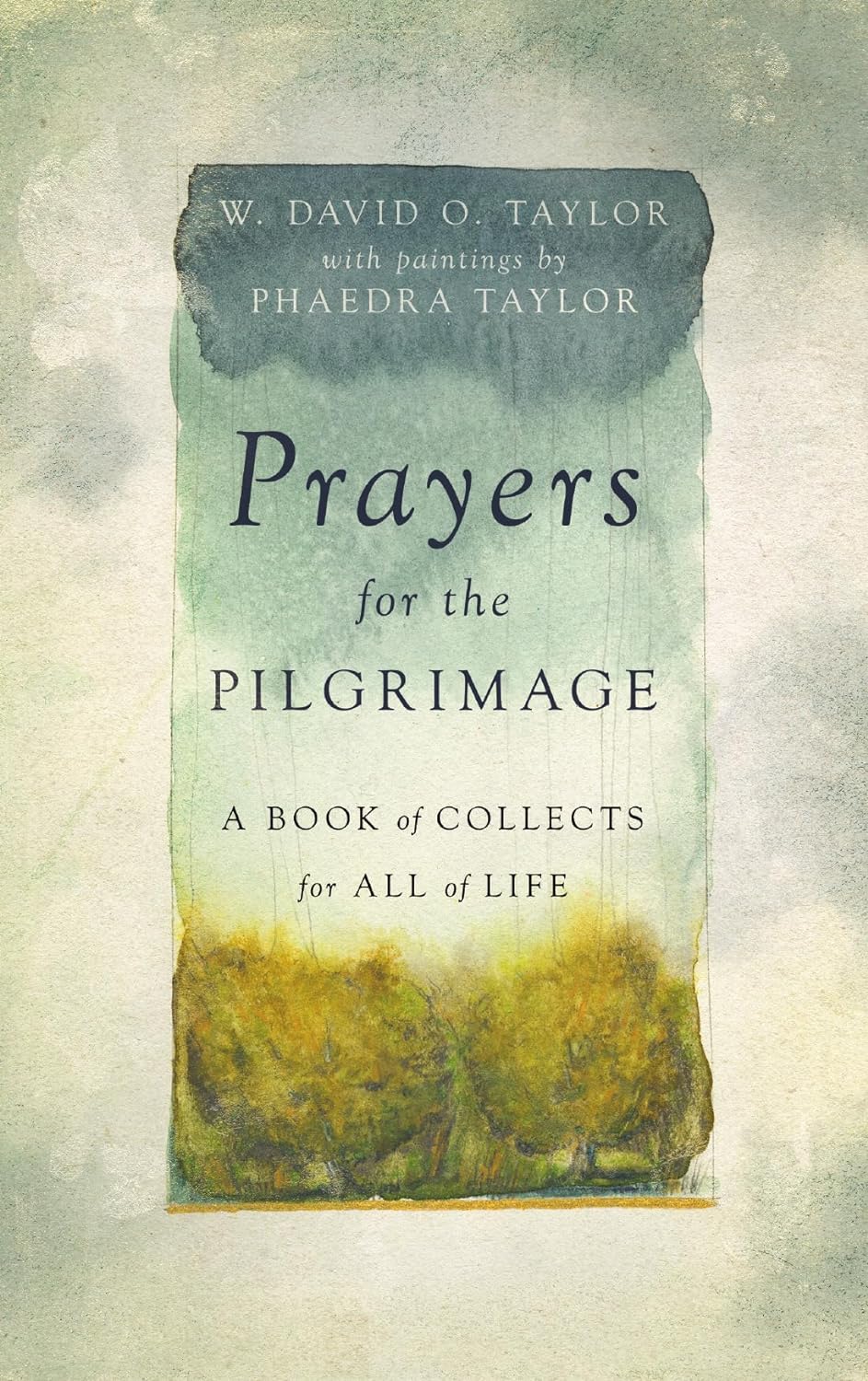
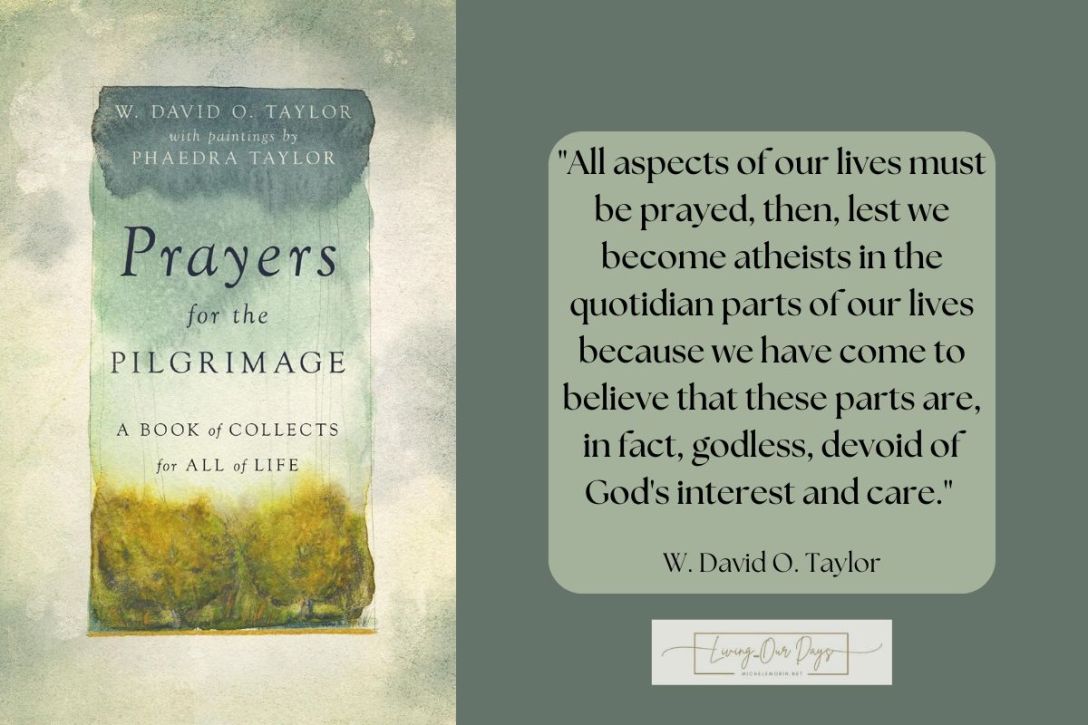
Prayers for the Pilgrimage is a collaborative offering from W. David and Phaedra Taylor with prayers arranged by topic and covering occasions for prayer from morning to evening, from doubt to faith, and from birth to death. They have mined the riches of the church calendar as well as the milestones of life’s pilgrimage to reveal the points that intersect with our daily need for God. The result is a beautifully illustrated hardcover volume of prayers for every aspect of life.
I found his analysis of the collect form particularly helpful for thinking about why we pray and about the content of my own extemporaneous prayers. A collect prayer names God, remembers his activity or attributes, states a petition and a desired hope, and then ends by naming God again.
The Taylors began writing and painting their prayers during the Covid-19 shutdown. Like all of us during that season, their lives became small enough to pay close attention to, and in posting his prayers on social media, Taylor found that they resonated across denominational and political lines. Short prayers anchored in the stuff of our daily lived experience bring God in close, which is where he wants to be.
“All aspects of our lives must be prayed, then, lest we become atheists in the quotidian parts of our lives because we have come to believe that these parts are, in fact, godless, devoid of God’s interest and care.” Our prayer lives flow from our theology, and I am beginning to see the startling truth that how I pray actually shapes my theology. My failure to pray cements in my mind the poor theology of a distant God.
Our prayer lives flow from our theology, and I am beginning to see the startling truth that how I pray actually shapes my theology. My failure to pray cements in my mind the poor theology of a distant God.
Tweet
I’ll be adding Prayers for the Pilgrimage to my stack of devotional resources along with my Bible, hymnal, and journal. As a substitute teacher (and the wife of a fourth-grade teacher), I’ll make solid use of the Prayers for School. As a listener to the news, I’ll be praying Prayers for a Violent World, and as a gardener on this country hill, I’ll enjoy repeating Nature Prayers.
In his poem entitled “Prayer,” George Herbert defines prayer as “the soul in paraphrase.” Can you picture yourself using the words of scripture, the words of historic, written prayers, or the offerings of collects written by a contemporary author to paraphrase your soul and carry your thoughts with fresh words to God?
What Other Reviewers Are Saying
“When two en-Spirited people, wife and husband, join to offer their gifts of writing and art in a single volume, the blessing is doubled for readers. As David and Phaedra Taylor share in this book what moves and inspires them, it will speak into your heart and mind as their words and images rise from the page to enrich you.” — Luci Shaw, writer-in-residence at Regent College and author of Reversing Entropy
“Prayers for the Pilgrimage is a thoughtful and delightful pairing of perceptive petitions and sensitive paintings, designed to tune the mind and heart to whispers of the eternal hidden in the everyday.” — Douglas McKelvey, author of Every Moment Holy
Holding you in the light,

“All aspects of our lives must be prayed lest we become atheists in the quotidian parts of our lives because we have come to believe that these parts are, in fact, godless, devoid of God’s interest and care.” @wdavidotaylor @ivpress
Tweet

Free Encouragement in Your Inbox!
On the third Thursday of every month, I send a newsletter with biblical encouragement straight to my subscribers’ email inboxes. Frequently, I share free resources, and the newsletter is where everything lands first.
CLICK HERE to read my most recent newsletter where you’ll be given the opportunity to subscribe. I’m committed to the truth that women can become confident followers of God and students of his Word, and I want to help you along that path.
Looking for Challenging Devotional Reading that Encourages You to Seek Intimacy with God Every Day?

As you know, I’m committed to the truth that women can become confident followers of God and students of his Word, and it’s my goal to help you along that path. At Living Our Days, I provide biblical content and resources to encourage biblical literacy and faithful living, and now I’m sharing devotional content on the YouVersion app. Visit my profile page to get free access to the reading plans!
I participate in the Amazon Services LLC Associates Program, an advertising program designed to provide a means for sites to earn advertising fees. If you should decide to purchase any of the books or products I’ve shared, simply click on the book title, and you’ll be taken directly to the seller. If you decide to buy, I’ll receive a few pennies at no extra cost to you.
Many thanks to InterVarsity Press for providing a copy of this book to facilitate my review, which is, of course, offered freely and with honesty.


 Living Our Days
I think written prayers help me focus; the times I pray off the top of my head I sometimes find myself with all these stray thoughts and weird side tangents.
LikeLike
I agree, and I think both kinds of prayer are important to have in our toolbelt.
LikeLike
While I don’t come from a background which uses written prayers, over the last ten years or so, I have found some of the old written prayers to be most comforting and encouraging. Written prayers spur my heart and mind to focus on the character of God, what He has done in the past, and that He is ever-present. “Our prayers are a lifeline, connecting us to the God who never blinks, never sleeps, and continually holds our best interests in his heart.” I so appreciate both the review and the recommendation.
LikeLike
Comforting and encouraging, yes! And they prime the pump for my own words, reminding me of the things I COULD be praying for. I appreciate your encouragement!
LikeLike
Written prayers are growing on me, Michele. I have a book by AW Tozer on some of his prayers which really surprised me. Thank you for the review of this book!
LikeLike
“Growing on me” too, Donna!
We’re on twin learning curves!
LikeLike
I’m Anglican but have not always been Anglican. I was a Baptist until 2021. I read morning or evening/compline prayers daily from The Book of Common Prayer. Some of the prayers are from the early church. I enjoy reading and praying through these fixed times of prayer using The Book of Common Prayer. I also pray silently, aloud, and carry on in a conversation with God as if He is a person nearby. I pray using Scripture. In the prayer book is a schedule for everyday Bible readings which will take you through most of the Bible in a year. There is an option to read through Psalms every month.
Another book that holds prayers is Saint Augustine’s Prayer Book.
Puritan prayers are also something I enjoy reading and utilizing in prayer.
Thank you. I enjoyed the review and write-up about prayer.
LikeLike
This is all such good information, and it coincides with another book I just finished reading and will be reviewing soon. The Riches of Your Grace by Julie Lane-Gay is an account of the author’s life, steeped in the blessing of the Book of Common Prayer. I have been greatly challenged by it.
And I am currently in the process of praying my way through the psalms at the rate of one per day, so I’m mightily intrigued by the BOCP’s schedule of working through the psalms in a month!
Thanks for reading and for taking time to leave this comprehensive input!
LikeLike
I haven’t liked to use written prayers just to do so, but like you said, sometimes they can be instructive to pray in ways or for things we hadn’t thought of. Tim Challies just linked to a post this week about writing out what we’re praying for others when we send them a note or card. A few times people have done that for me, and it was so touching.
LikeLike
That’s a wonderful idea. I have done that sometimes on social media when someone has asked for prayer, and it’s a good way for me to make sure I pray for the person at least once.
LikeLiked by 1 person
Thank you for this review Michele. I come from a very strict set prayer background while growing up & when I came to the Lord it was such a revelation that I could talk to God in prayer as a conversation that I have never looked back.
This has been such a blessing in my life over the past four & half decades with the Lord that I still shy away from any type of written prayers. But I do acknowledge they have a place in other’s lives.
Blessings, Jennifer
LikeLike
I can certainly see why that would be true, Jennifer. Conversely, in my tradition, I have grown tired of people crashing into the presence of God as if they had an agenda and God was on their payroll. There are abuses of prayer in every camp, and I appreciate your openness to reading and responding to this post which could have been troubling to you.
LikeLike
Another book of written prayers that’s ministered deeply to me is Douglas McKelvey’s Every Moment Holy. He’s written prayers for such occasions as watching a sunset, doing the laundry, even changing diapers! I’ve also collected about two dozen prayers from various sources that spoke for me what I would have said if I’d thought of it (just as you said, Michele)! I too grew up in a tradition that thought written prayers were too stilted. But there’s a wealth of heart-touching, soul-searching prayers in ink that are anything but artificial.
LikeLike
I have heard so much about that book. Adding it to my list, Nancy!
LikeLike
I have been to many different Christian churches in my lifetime. Some I have stayed at for a year or two and others only one visit. What I have learned from these experiences is that it doesn’t matter how you pray, it only matters that you pray.
LikeLike
If only we could enter into the earth shattering truth that the God of the universe actually attends to our words. Amazing!
LikeLike
I’m not use to pre-written prayers, but my interest is peeked, Michele. Thanks for the book review and the recommendation.
LikeLiked by 1 person
Thanks for your openness! It’s always a joy to hear from you.
LikeLike
Like you, I didn’t (and still don’t) come from a tradition that often uses written prayers. Still, as I’ve gotten older, I’ve come to appreciate the supplications, praises, laments, and even confessions of others, and use them to supplement my own prayers–which are often in written form!
LikeLiked by 1 person
I admire your diligence in writing out your prayers. Whenever I’ve done that in the past, it has really helped to slow me down and focus my prayers.
LikeLike
I really like how it explains prayer in a simple way! Prayer is like talking to God about everything in our life. We can talk to God about our day, our worries, and the things that make us happy. I think it’s cool that prayer can be for kids too, not just grown-ups!
LikeLike
Some of the sweetest prayers I have ever heard have come from kids!
LikeLike