
Early in the year, I invested several weeks in an attempt to memorize The Nicene Creed. It’s not as if I didn’t already know what its words reveal about the nature of God. I just wanted those particular words in my tool belt to remind me of all I can and should be remembering and appreciating about God.
I discovered the archaic words of the creed as a welcome mat into sturdy worship. God is great and incomprehensible no matter how I happen to be feeling at the moment. Christ’s saving work has an impact that far exceeds my own small faith story. He is the LORD “whose kingdom shall have no end.” And far from being a mere misty and wispy trinitarian afterthought, the Holy Spirit is the Voice behind the prophetic record and completely worthy of our worship.
The Nicene Creed is a welcome mat into sturdy worship. God is great no matter how I happen to be feeling at the moment. Christ’s saving work has impact that exceeds my small faith story. He is the LORD whose kingdom shall have no end.
Tweet
Borrowed words are finding their way into my devotional practices, not as a replacement for my own heart’s expression to God, but as an outline, a trellis upon which I can hang my own specific thoughts and prayers. Therefore, when I heard a podcast in which Julie Lane-Gray explained her use of The Book of Common Prayer in her everyday “sleeping, eating, going-to-work, and walking-around life,” 1 she had my immediate attention, and I went in search of her book!
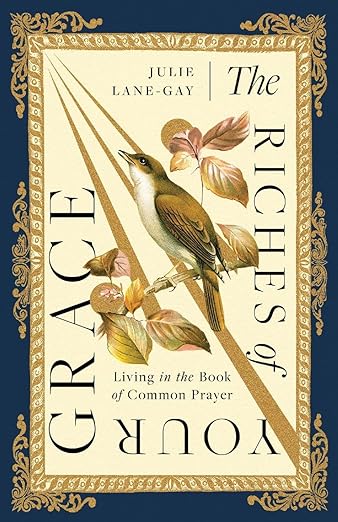
Lane-Gay points to the 450-year-old collection of prayers as the single most important influence in shaping her Christian life, and in The Riches of Your Grace, she tells the story of learning to live in the prayer book as a layperson.
Instead of giving her readers a mere handbook, she has thrown open a door of welcome to join her in her own very meaningful practices of morning and evening prayer using the Daily Office and the Collects. She forges into the ways of the Liturgical Year and discovers that an annual refresher in the Catechism helps to reground her understanding of what she believes. She discovers the enhancement ageless wisdom can bring to corporate worship and to her understanding of what it means to be the church.
It goes without saying (and yet, I will say it anyway), that the particular words of The Book of Common Prayer are not inspired in the same way that scripture is inspired. They have no spiritual energy and are not powerful in themselves. Prayer is communication with God. He is where the power lies, and he responds to the believing heart that reaches out to him.
A common objection to the use of traditional prayers is that they can become vain repetition. Of course, it is also possible for our spontaneous prayers to become rote and meaningless. Repetitive prayer is not the problem, and it’s not what Jesus prohibits in his Sermon on the Mount. Vain repetition is the problem. Right meaning wedded to right intention is the recipe for genuine prayer.
I have yet to purchase a Book of Common Prayer, and I’m still rereading and reviewing Julie Lane-Gay’s thoughts. I’m intrigued by the notion that uniting one’s own prayers with words that have been prayed for centuries and are being offered throughout the whole world situates the believer in company with other Christians. “We might not know each other, but together we are progressing through the shared language and story of scripture.” In this time of deep division and distrust within the church, may we discover and celebrate the truth that God meets us on the path of prayer, carrying grace and offering us the gift of himself.
What Other Reviewers Are Saying
“‘Something deep and sturdy’ is how Julie Lane-Gay characterized the power resident in the Anglican Book of Common Prayer when she was first invited to make it a part of her daily life. As a mother of children and editor at Regent College, her times of devotional reading and prayer were limited. But in this glowing new book she details how the seminal ancient prayers and responses of the prayer book began to sink into her spirit, becoming as warm and powerful as glowing coals as they fed her burgeoning spiritual life.” — Luci Shaw, author of Reversing Entropy and The O in Hope
“Julie Lane-Gay is guide and fellow explorer in this rich contemplation of the Book of Common Prayer. Her personal journey through an ancient text of Anglicanism is honest and poetic. As she reads the Book of Common Prayer at church and at home, the book reads her, and we all benefit. The Book of Common Prayer can at first seem formal and a bit complicated for some of us, but in Lane-Gay’s skilled and sensitive hands, we experience how it opens the mysteries of God’s grace, love, and direction in our daily lives. I put down this book and felt encouraged to pick up that ‘small red book’ once again.” — Karen Stiller, author of Holiness Here: Searching for God in the Ordinary Events of Everyday Life and The Minister’s Wife: A Memoir of Faith, Doubt, Friendship, Loneliness, Forgiveness, and More
- From Romans 12:1-2, The Message ↩︎
Holding You in the Light,
In The Riches of Your Grace, Julie Lane-Gay has thrown open a door of welcome to join her in her own very meaningful practices as she lives in the Book of Common Prayer. @ivpress
Tweet

Free Encouragement in Your Inbox!
On the third Thursday of every month, I send a newsletter with biblical encouragement straight to my subscribers’ email inboxes. Frequently, I share free resources, and the newsletter is where everything lands first.
CLICK HERE to read my most recent newsletter where you’ll be given the opportunity to subscribe. I’m committed to the truth that women can become confident followers of God and students of his Word, and I want to help you along that path.
Looking for Challenging Devotional Reading that Encourages You to Seek Intimacy with God Every Day?

As you know, I’m committed to the truth that women can become confident followers of God and students of his Word, and it’s my goal to help you along that path. At Living Our Days, I provide biblical content and resources to encourage biblical literacy and faithful living, and now I’m sharing devotional content on the YouVersion app. Visit my profile page to get free access to the reading plans!
I participate in the Amazon Services LLC Associates Program, an advertising program designed to provide a means for sites to earn advertising fees. If you should decide to purchase any of the books or products I’ve shared, simply click on the book title, and you’ll be taken directly to the seller. If you decide to buy, I’ll receive a few pennies at no extra cost to you.
Many thanks to InterVarsity Press for providing a copy of this book to facilitate my review, which is, of course, offered freely and with honesty.


 Living Our Days
I read either morning or evening/compline prayers most days. In The Book of Common Prayer there is a Bible reading schedule which includes a choice to read through Psalms every 30 days. In The Book of Common Prayer, the book of Psalms is included.
When reading either the morning or evening prayer, Bible reading accompanies it. If read every day, most of the Bible will be read through every year.
LikeLike
This is EXACTLY what I discovered and hadn’t known before, and I feel as if I have been missing out on something amazing! Thanks for sharing this with us!
LikeLike
Michele, love your question here. I’ve used the Divine Hours and the Book of Common Prayer for Ordinary Radicals. I find these prayers provocative and rich, and they lead me on to even more intimate prayer times.
LikeLike
I have so much respect for your prayer practices and your intimacy with God. Thank you for letting your spiritual disciplines spill over into your writing for the benefit of your readers.
LikeLike
Growing up Catholic, there’s much scripture recited during the liturgy. It took me years to realize that I had actually memorized scripture – by the twice weekly recitations. I think if I set to, with some refreshing I could recite the Nicene Creed – but I kind of cheat on that now because so much of it is in “I Believe” by the Newsboys. I have a handed-down vintage book of Common Prayer – and at times I go into it and spend time in it – and, use it as you say, ” a trellis upon which I can hang my own specific thoughts and prayers.” Growing up in such a liturgical worship, it required intentionality to “mean” what you are praying – and I have often wondered if some don’t use the excuse of empty repetition to just not – yet I have found that the repetition from the masses of my youth to have gone deeply into my spirit – and were there to pull out when I determined to be intentional. I am so glad people are turning their eyes to some of the valuable old books that contain so much goodness.
LikeLike
What a rich background for your present-day spiritual practices. I think the ancient prayers and creeds are so important for us in knowing how to pray beyond what we’re feeling in the moment. They remind me of all the things I need to be thanking and praising God for!
LikeLike
[…] year, the Nicene Creed celebrates its 1700th birthday.Maybe you attend a church where the creed is recited every Sunday.Or […]
LikeLike