I spent most of my twenties looking in the mirror at a face I didn’t love. Makeup interventions, hairstyle adjustments, and even color analysis failed to take the edge off my conviction that something about my face was simply not right.
Around the same time, I discovered C.S. Lewis’s Till We Have Faces and felt a strong kinship with Orual, the sad and ugly sister who resolved to go through life wearing a veil. Young-adult histrionics aside, Orual’s veiled life reminded me that the believer comes before God unveiled. Even now, she warns me of the dangers of damming up emotions, slamming the door on things I’d rather not deal with, and working hard to project an image that does not line up with the “me” that lives and breathes (and fails and falters) on this broken ground.
It turns out I was correct in assessing the difference between my face, my jaw alignment, and the rest of the world. Sadly, however, I drew the wrong conclusion and wasted a lot of time. Learning to love the face I had been given feels like long-ago history, but I was reminded of the experience as I read about Russell Joyce’s story in His Face Like Mine.
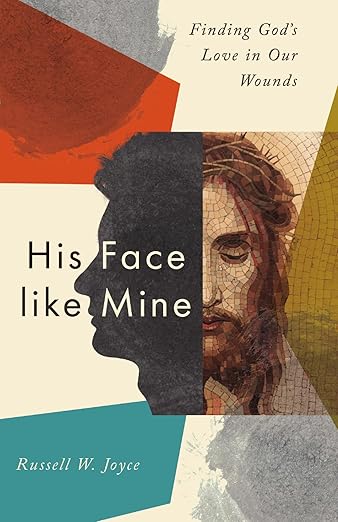
Born with a rare craniofacial disorder called Goldenhar syndrome, the left side of Joyce’s face and parts of his body were badly broken. He lost track of the number of reparative surgeries he had to endure as doctors attempted to rebuild a left ear or create a jaw bone from a piece of transplanted rib.
His story included years of feeling incomplete, of being rejected by peers. The struggle to be whole in spirit despite his physical wounds has left him uniquely qualified to write about the soul wounds we all carry. His arrival at the conclusion that he is “broken but not ugly” has everything to do with finding his acceptance in the love of God.
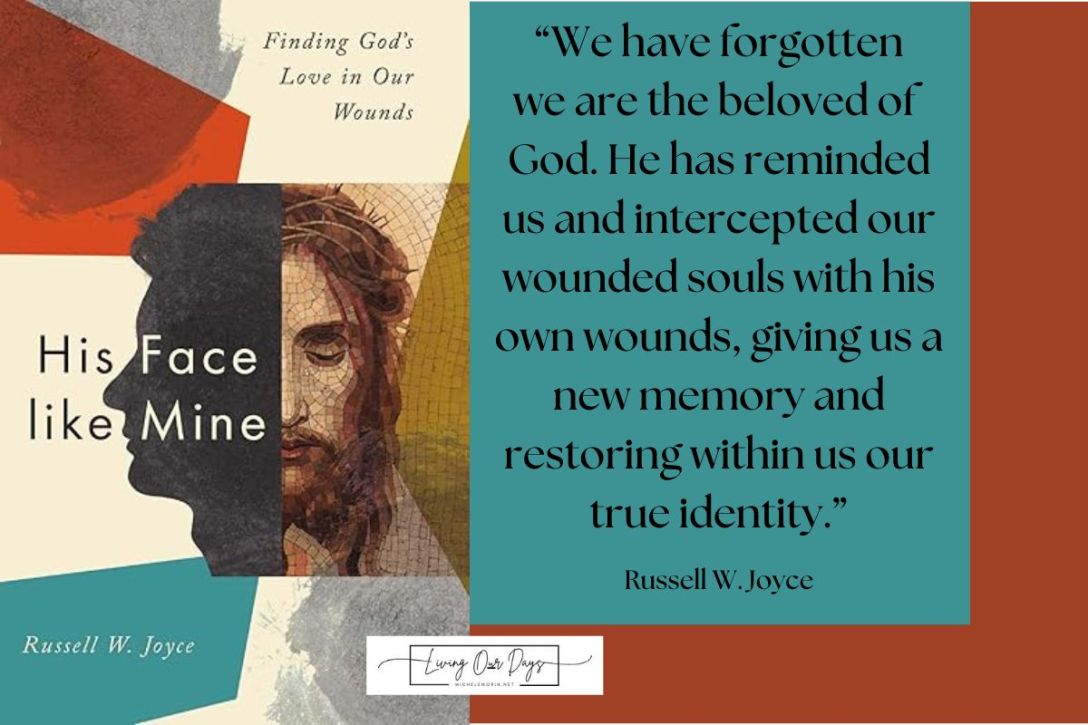
We have forgotten we are the beloved of God. He has reminded us and intercepted our wounded souls with his own wounds, giving us a new memory and restoring within us our true identity.”
His healing process also blazes a trail for readers in the struggle to relate well in marriage and to curate a healthy relationship with work and success. I appreciated the deep soul work that took him into the writings of historical Christians on our suffering and our union with Christ:
- George MacDonald convinced Joyce that our suffering is never pointless: “Jesus suffered unto death not that men might not suffer, but that their suffering might be like his, and lead them up to his perfection.”
- Augustine pushed back against his unfounded feelings of isolation: “God, you are more in me than I am in me.”
- C.S. Lewis provided context for the often insensitive responses aimed at those who suffer: “They say of some temporal suffering, ‘No future bliss can make up for it,’ not knowing that Heaven, once attained, will work backward and turn even that agony into glory.”
Digging into scripture, Joyce discovered God as the one who “invites us to remove the veil.” Accepting the invitation to “contemplate the Lord’s glory, [to be] transformed into his image,” he experienced the love of a Savior who knows what it is to bear the scars that come with life in a broken world. His work leaves a trail toward restoration and hope for others who need healing.
Learning to love our given life, our given family, our given face requires a gritty embrace of God’s sovereignty and a willingness to relax into God’s love. Most of us will never experience the pain—much less the lifelong medical and social implications—of a congenital craniofacial disorder. Even so, on a smaller scale, we can take grace for the open-handed surrender and the grateful acceptance of whatever given situation or characteristic we wish we could change. Faith receives the given life from God’s good hand.
What Other Reviewers Are Saying
“Russell’s work is a fresh and vulnerable look at the good news of Jesus’ grace. By mingling personal stories with scriptural reflections, he puts forth an embodied apologetic that aims to disarm us all of our false selves, look a little deeper into the depths of our souls, and find the Savior who was there the whole time ready to set us free by his love.” — Alan Hirsch, author and founder of Movement Leaders Collective and Forge Missional Training Network
“For anyone grappling with adversity, be it in the form of visible scars or hidden wounds, this book stands as a testament to the possibility of being made whole in Christ. Russell’s narrative serves as a beacon of hope, challenging readers to perceive their own trials through a lens of divine purpose. His Face like Mine is an eloquent reminder that, in the hands of a compassionate God, even the most catastrophic events can be transmuted into opportunities for profound personal and collective growth.” — Edwin Colon, pastor of Next Step Community Church in Brooklyn, New York
Holding You in the Light,

“We have forgotten we are the beloved of God. He has reminded us and intercepted our wounded souls with his own wounds, giving us a new memory and restoring within us our true identity.” ~Russell Joyce in His Face Like Mine @ivpress
Tweet
See all my Given—One Word 2024 posts here.

Free Encouragement in Your Inbox!
On the third Thursday of every month, I send a newsletter with biblical encouragement straight to my subscribers’ email inboxes. Frequently, I share free resources, and the newsletter is where everything lands first.
CLICK HERE to read my most recent newsletter where you’ll be given the opportunity to subscribe. I’m committed to the truth that women can become confident followers of God and students of his Word, and I want to help you along that path.
Looking for Challenging Devotional Reading that Encourages You to Seek Intimacy with God Every Day?

As you know, I’m committed to the truth that women can become confident followers of God and students of his Word, and it’s my goal to help you along that path. At Living Our Days, I provide biblical content and resources to encourage biblical literacy and faithful living, and now I’m sharing devotional content on the YouVersion app. Visit my profile page to get free access to the reading plans!
I participate in the Amazon Services LLC Associates Program, an advertising program designed to provide a means for sites to earn advertising fees. If you should decide to purchase any of the books or products I’ve shared, simply click on the book title, and you’ll be taken directly to the seller. If you decide to buy, I’ll receive a few pennies at no extra cost to you.
Many thanks to InterVarsity Press for providing a copy of this book to facilitate my review, which is, of course, offered freely and with honesty.


 Living Our Days
Very well said.
LikeLike
Thank you!
I appreciate your input!
LikeLiked by 1 person
Good morning, Michele. I will read your actual post and comment later, but I just wanted to say wow, what a great headline!
Hope you have a wonderful day!
❤️Lois
Lois Flowers
Blog: http://www.loisflowers.comhttps://www.loisflowers.com/
LinkedIn: Lois Flowershttps://www.linkedin.com/in/writerloisflowers/
Instagram Community: @rememberingourparentshttps://www.instagram.com/rememberingourparents/
Personal Instagram: @loisflowershttps://www.instagram.com/loisflowers/
“If I find in myself a desire which no experience in this world can satisfy, the most probable explanation is that I was made for another world.” ~ C.S. Lewis in Mere Christianity
LikeLike
Ha! Thanks for that encouragement! I STRUGGLE with those post titles every single time!
LikeLiked by 1 person
Well, I came here to read the post and realized my email from this morning turned into a comment. (I must have hit the wrong button.) Sorry about all that extra stuff after my name … feel free to delete it!
LikeLike
No problem, Lois!
LikeLike
“Learning to love our given life, our given family, our given face requires a gritty embrace of God’s sovereignty and a willingness to relax into God’s love.” This is a most powerful thought. Wonderful review and post. I’ll be thinking on this all day.
LikeLike
The book was powerful in the author’s simple embrace of God’s sovereignty. Nothing is accidental or inconsequential when we offer it to God.
LikeLike
Michele, your post title grabbed my attention too, especially since my first thought after our Zoom Bible study last night was to ask my hairdresser if there is anything she can do to perk up my look! I appreciate your thoughts and what you share from this book. It provides a much needed reminder of who we really are and what really matters in this passing world.
LikeLike
Interesting, especially as our Bible study class has just gone through parts of 2 Corinthians talking about the veils–Moses’ veil, the veil hiding the gospel from people’s hearts, etc. “But when one turns to the Lord, the veil is removed” (3:16). What a wonder to stand before the Lord, the perfect one, unveiled in all our imperfections, fully accepted in the Beloved. And then, as we “look full in His wonderful face, “we all, with unveiled face, beholding the glory of the Lord, are being transformed into the same image from one degree of glory to another” (3:18).
LikeLike
Amen.
We look forward to that day of unveiled faces with the joy of knowing that our hope has already “entered the inner place behind the veil!”
LikeLiked by 1 person
Thanks for the book recommendation, Michele. This sounds like a gem.
LikeLike
Sounds like an impactful book, Michele! I try not to obsess about the ever-increasing wrinkles, crows feet, and sagging skin, but every now and then I wish that when we reached adulthood, our bodies and faces stayed the same until we died! Perhaps God created us to age in order to add more anticipation for heaven, where “the old order of things has passed away (Revelation 21:4)! Hallelujah!
LikeLike
Aging definitely helps us to see where our hope is built. And right now I seem to have a lot of people who are aging very quickly and all at once which makes me sad…
LikeLike
(I tried leaving a comment a few days ago, but it must not have gone through…trying again)
I sometimes look back at pictures of me in my youth and think–I wish I had that body now. Yet I remember how negatively I felt toward my body even back then! Learning to accept and love and appreciate our bodies is a lifelong lesson, amplified through the changes our bodies continue to make as we age. I love your line: “Even so, on a smaller scale, we can take grace for the open-handed surrender and the grateful acceptance of whatever given situation or characteristic we wish we could change.” Grace for surrender and acceptance, yes!
LikeLike
Thank you for persevering!
I have had the exact same experience with old photos—which makes me wonder how my future self will respond to today’s body…
LikeLike