My days in elementary school classrooms offer me a priceless window into the minds of young humans. In some ways, the things they value, the hand-holds they grip for meaning and significance, haven’t changed since I was in elementary school. There’s really no such thing as “the good old days.”
Athleticism, confidence, a snappy personality, and an “acceptable” wardrobe ranked just as high in 1969 as they do today, and, like the students I see now, we ranked one another based on valued traits. We also had a pretty way of devaluing anyone who didn’t fit the mold.
The difference I see in children today can be traced to the difference in adults. Somewhere along the way, we’ve lost the cords of truth that anchor our value to our identity as God’s image bearers. We might even believe that we’re living “a purpose-driven life,” but our purpose is likely either internal or horizontal. Without the vertical connection to a Creator who defines meaning, it’s a tough assignment to come up with a solid answer to the question, “What is man?”
Anthropology is the branch of theology that seeks to provide a biblical answer to this question. Are we free and autonomous, masters of our own fate and captains of our souls? Do we have defined limits or creaturely obligations to a Creator or do we, as little gods, define ourselves?
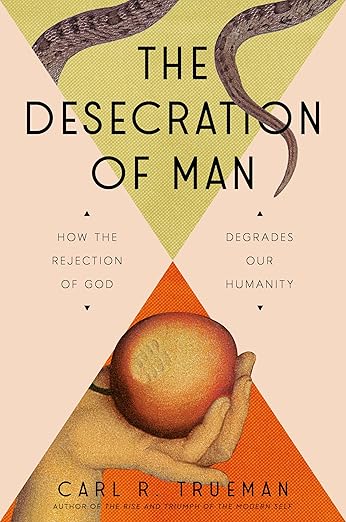
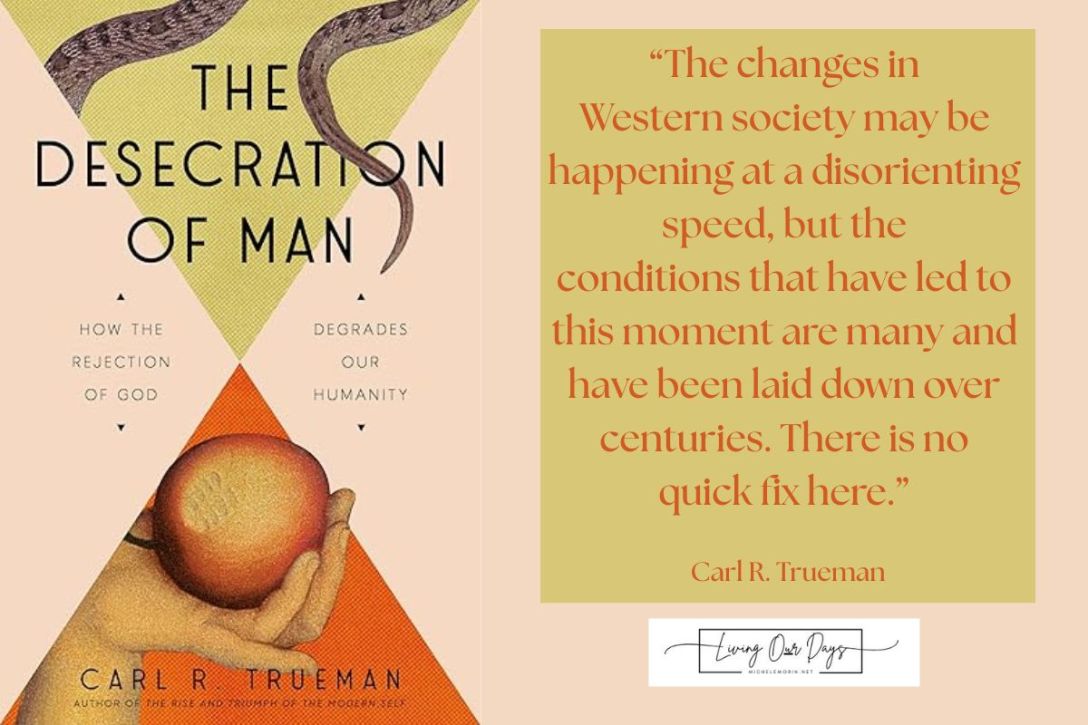
In The Desecration of Man, Carl R. Trueman sets forth a uniquely Christian anthropology that accounts for our privileged position as God’s image bearers. He traces humanity’s rejection of God and our loss of connection to the transcendent through our love affair with technology, the detachment of sex from God’s original design, and the separation of “Christianity” from a robust commitment to the faith. His use of the word desecration forces the reader to do business with the loss we’ve experienced to our personhood and to our connection with a holy God.
In The Desecration of Man, Carl R. Trueman’s use of the word “desecration” forces the reader to do business with the loss we’ve experienced to our personhood and to our connection with a holy God. @penguinrandom
Tweet
Rapid changes in our “social imaginary,” including the public acceptance of immorality and the decline in society’s value of life for its own sake, are trail markers on a downward path, so Trueman offers only guarded hope: “The changes in Western society may be happening at a disorienting speed, but the conditions that have led to this moment are many and have been laid down over centuries. There is no quick fix here.“
Even so, I was encouraged by the book’s guidelines for a slow fix, an acknowledgement that “the answer to desecration is consecration.” Consecration must involve both the intellect and the imagination of humanity. Our beliefs shape our worship, and both are crucial for shaping our ethics and our relationships.
Trueman asserts that the church is the most reasonable and obvious place for this chain reaction of rescue to occur, for the claims of Christianity are both corporate and historical. Through prayer, singing, and meaningful dialogue, we affirm the beliefs that tie us back to our Creator and to our true identity as his image bearers. Then, rooted in right belief, we care for one another and extend the love of Christ to the least, the last, and the lost.
The long game of hospitality and ordinary habits of holiness become acts of cultural warfare when we realize that this is how the early church turned the world upside down. (Acts 17:6)
Holding You in the Light,
The long game of hospitality and ordinary habits of holiness become acts of cultural warfare when we realize that this is how the early church turned the world upside down. (Acts 17:6) #TheDesecrationofMan
Tweet

More Biblical Encouragement for You on the YouVersion App
As you know, I’m committed to the truth that women can become confident followers of God and students of his Word, and it’s my goal to help you along that path. At Living Our Days, I provide biblical content and resources to encourage biblical literacy and faithful living, and now I’m sharing devotional content on the YouVersion app. Visit my profile page to get free access to all the reading plans!
Have You Read the Latest Newsletter?
On the third Wednesday of every month, I send a newsletter with biblical encouragement straight to my subscribers’ email inboxes. Frequently, I share free resources, and the newsletter is where all the news lands first.
CLICK HERE to find me on Substack, where my goal is to help you on the path of becoming a confident follower of God and a student of His Word.
Disclosure: I am an Amazon Associate, which means that whenever you purchase a book I’ve shared here through the link I provide, I’ll receive a very small commission. It doesn’t cost you more, and I
Many thanks to Sentinel (a division of Penguin Random House) and NetGalley for providing a copy of this book to facilitate my review, which is, of course, offered freely and with honesty.


 Living Our Days
Given that I have been thinking about the aging process and crisis, this post gave much food for thought. His assertion the most obvious place for change to begin is in the church is one I agree with. “Then, rooted in right belief, we care for one another and extend the love of Christ to the least, the last, and the lost.” Yes, and Amen!
LikeLike