This morning, I watched three crows swaggering like pirates in our backyard. Rain had watered the grass to a brilliant emerald, and summer leaves hung their weight low on the oaks. The same window in another season offers a different beauty, and my only responsibility is to look out the window, take myself by the scruff of the neck, and remind myself to really see it. Seeing and savoring beauty becomes a gateway to worship for the believer, because we know “the earth is the Lord’s and the fullness thereof, the world and those who dwell therein.” 1
Seeing with both our eyes and savoring the beauty with our whole hearts provides fuel for our imaginations. In the same way, when we open our sacred text, we are looking through a God-given window into the beauty of our Lord, his great salvation, and the blindingly beautiful metanarrative of his work among his people. Apart from this seeing, there will be no effective communication of biblical truth.
Whether we’re sharing the gospel with unbelievers, making disciples within a classroom setting, or writing with the goal of spiritual formation, our aim is first to see what God is doing. The Holy Spirit empowers the seeing, and we trust him, then, to empower the saying.
Sharing the gospel with unbelievers, making disciples within a classroom, or writing with the goal of spiritual formation, our aim is first to see what God is doing. The Spirit empowers the seeing and we trust him to empower the saying
Tweet
Pioneer missionary Lilias Trotter looked at the world with an artist’s eye and then conveyed what she saw through her exquisite paintings of the natural world, first in her home in England and, then, in Algiers, Africa, the home of her calling. Lilias added colorful illustrations from nature to her books and her letters home to invite her readers into her world. “The colour pages and the letters are with one and the same intent, to make you see. Many things begin with seeing in this world of ours.”
That intense connection between the created world and the world of her imagination can be traced directly to the early artistic training Lilias received from John Ruskin, the renowned art critic who recognized her gift for painting and offered to give her lessons. He taught her that “the greatest thing a human soul ever does in this world is to see something and tell what it saw in a plain way.”
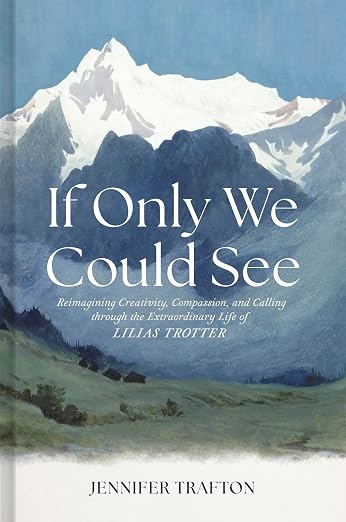
In If Only We Could See, Jennifer Trafton traces the life story of Lilias Trotter from her birth in London in 1853, through her artistic training under Ruskin, and her
calling to serve in Algiers, North Africa in 1888 at the age of 35. Consistent with the practice of that day, she spent the remainder of her life in North Africa until she died in 1928.
Her itinerant work there eventually led to her establishing the Algiers Mission Board as the first Protestant woman to found and lead her own mission organization. Although she possessed a talent for watercolor that could have led to a lucrative career as an artist, she did not view her life choice as a decision to sacrifice art for a higher cause. For 40 years, she employed her art in the service of Christ and his kingdom.
In her reflections on creativity, compassion, and calling, Jennifer Trafton writes as if introducing her readers to a friend while also sharing the very personal story of her own life as it intersected with her appreciation for “Lily” (as she referred to Trotter). Lilias Trotter was truly ahead of her time, turning her back on the expectations for an upper-class woman of the Victorian era and embarking on adventures in the Saharan Desert on camelback, always with her paints in tow.
Her teaching portrayed a gospel that could thrive in every culture where God was at work, not a Western construct. Her love for science did not conflict with her Christianity, but rather enhanced her curiosity and her ability to connect and build relationships within a patriarchal Muslim context. Her goal was to establish an indigenous Algerian church, and her work among the people led them to conclude, “No one ever loved us like this before.”
Drawing a clear and straight connection back to her beloved desert flowers, Trotter’s ministry was founded on the principle that only God can make things grow. As his faithful servant, she created the conditions for growth to happen, scattering seeds and waiting for fruit to ripen. With this in mind, readers must understand her late-Victorian context and read with generosity the generalizations her words sometimes conveyed and her tendency to overwork to the point of exhaustion, so common among missionaries of that era.
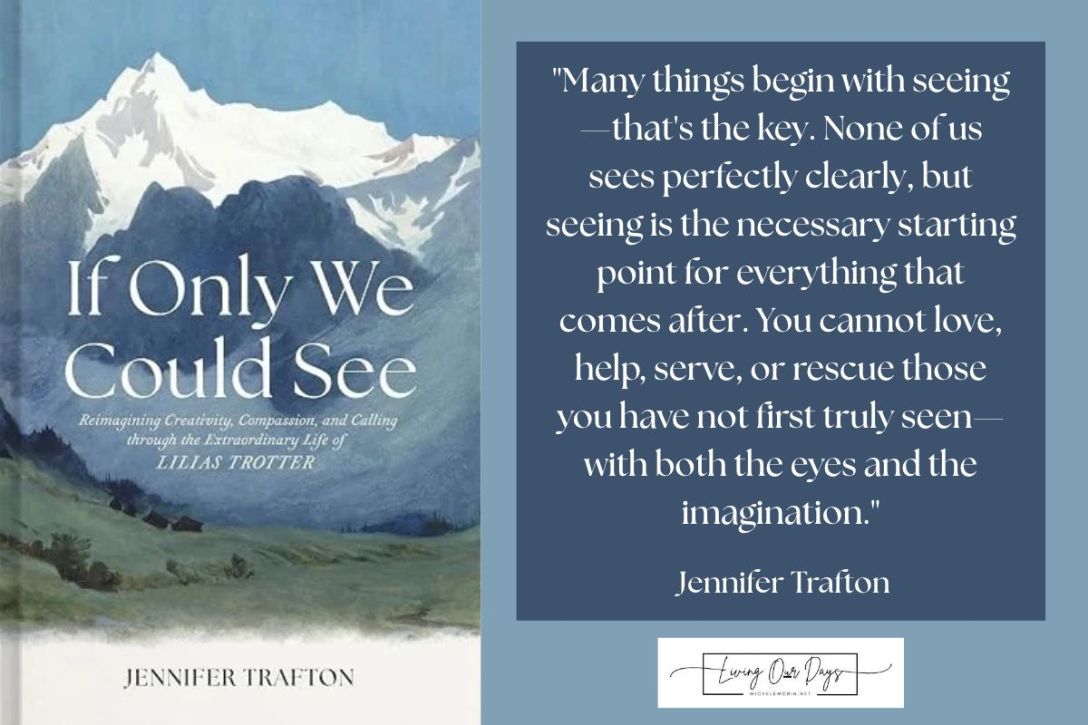
Failing health confined her to bed for her final four years, allowing her to write and publish the books for which she is best known (Parables of the Cross and Parables of the Christ Life) in which she shares beautifully the seeing and the savoring of God’s world and his word. Trafton’s retelling of Lilias’s story concludes that “many things begin with seeing—that’s the key. None of us sees perfectly clearly, but seeing is the necessary starting point for everything that comes after. You cannot love, help, serve, or rescue those you have not first truly seen—with both the eyes and the imagination.”
May each of us follow the pathway of the Divine Artist.
Jennifer Trafton introduces her readers to the life of Lilias Trotter with the assertion that “you cannot love, help, serve, or rescue those you have not first truly seen—with both the eyes and the imagination.” @BHPub
Tweet
Holding You in the Light,
- Psalm 24:1 ↩︎
If you love to read missionary biographies, click on over to my review of a recent biography of Ann Judson, pioneer missionary to Burma.
Have You Read the Latest Newsletter?
On the third Wednesday of every month, I send a newsletter with biblical encouragement straight to my subscribers’ email inboxes. Frequently, I share free resources, and the newsletter is where all the news lands first.
CLICK HERE to find me on Substack, where my goal is to help you on the path of becoming a confident follower of God and a student of His Word.

New for You on the Bible App!
This seven-day devotional plan affirms that perseverance is so much more than simply hanging on. Those who follow Jesus Christ are familiar with the dogged patience of waiting, because we have read the words of Scripture about eternal rewards for those who endure. So we persevere—sometimes just because God has commanded us to. When the newness wears off, when we don’t feel like it, when everything just feels too hard, we press on, and we press in to Christ. He is the prize.
As you know, I’m committed to the truth that women can become confident followers of God and students of his Word, and it’s my goal to help you along that path. At Living Our Days, I provide biblical content and resources to encourage biblical literacy and faithful living, and now I’m sharing devotional content on the YouVersion app. Visit my profile page to get free access to all the reading plans!
Disclosure: I am an Amazon Associate, which means that whenever you purchase a book I’ve shared here through the link I provide, I’ll receive a very small commission. It doesn’t cost you more, and I only share books here that I can wholeheartedly recommend.
Many thanks to B&H Publishing and NetGalley for providing a copy of this book to facilitate my review, which is, of course, offered freely and with honesty.


 Living Our Days
Despite my art education, I hadn’t heard of Lilias Trotter until just a few years ago. What an amazing woman, and her art is beautiful. Seeing or looking carefully at something before we make art about it is what I’m always telling my students and reminding them that creation shows the reality and beauty of our Creator. thanks for reviewing this book about Lilias!
LikeLike
Just yesterday, I had the fun of introducing my grandkids to a weed that grows more northerly in the state of Maine. (Bladder campion) It’s an unassuming plant, but it makes a fun popping sound when you smash it against the back of your hand, and they were enthralled with it. I was so happy to see and then share that little piece of history from my own Northern Maine childhood.
LikeLike
I’m not familiar with that plant, but I grew up in mid to southern Maine, so maybe it doesn’t exist there?
LikeLike
I haven’t given them a thought in my adult life, but when I saw them, the memory of that popping sound returned. So surprising to me because I was not even remotely an outdoorsy kid.
LikeLike
I wrote about Lilias Trotter on my blog several years ago. What an amazing woman! I love how God took her talent and love for painting and used it as part of her ministry in Algiers. You are so right (and Lilias would agree): “Seeing and savoring beauty becomes a gateway to worship.” And worship augments the experience of seeing and savoring, which leads to greater joy.
LikeLike
This bio has made me want to reread Elisabeth Elliot’s book on suffering. She refers to Lilias’s work and quotes from it, and when I first read that book, I wasn’t as familiar with Lilias Trotter.
LikeLike
Michele, I was interested to see this post because a dear friend of mine just wrote a children’s book about Lilias Trotter (it’s called “Desert Lily: The Life of Missionary Lilias Trotter.”) I was not familiar with Trotter before my friend told me about her; she sounds like a remarkable woman! I also love John Ruskin’s advice to Lilias: “the greatest thing a human soul ever does in this world is to see something and tell what it saw in a plain way.”
LikeLike
I was really drawn to that quote as well, and it seems sort of “coincidental” to me that the seeing clearly and then telling clearly has been a real focal point for me this year in my writing. If I don’t see the truth in the first place, I won’t get it right when I try to convey it to readers.
LikeLike