We’ve all met the woman who treats her daily quiet time like a lucky rabbit’s foot or a spiritual vitamin pill. And we’ve heard from the guy who announces financial blessings in direct proportion to how long he fasts or prays.
In an article at Christianity Today, James Bryan Smith pressed on that fragile boundary line between legalism and the faithful practices of Christian spiritual formation:
And if I believe that God metes out punishment and blessings based on my religious practices, I will quickly turn the disciplines into legalism.”
Like the Pharisees in Jesus’s day, we haven’t lost our talent for turning good things into ultimate things, for losing the why in the weeds of technique and trappings. What happens, then, in the heart of a sincere Christ-follower who begins to superimpose a checklist onto Jesus’s words in the Sermon on the Mount? Should we be reading the Beatitudes strictly as a blueprint for righteous living?
Descriptive or Prescriptive?
My slow read through Matthew 5-7, Jesus’s Sermon on the Mount has raised some questions, mainly because I’m reading repetitively, trying to memorize what I can, and putting myself in the company of those who sat with Jesus on the day that he “saw the crowds” and “opened his mouth and taught them.”
I have received considerable assistance in my approach from Fleming Rutledge’s simple distinction between two categories of biblical teaching. Some words in Scripture are clearly prescriptive. “Believe on the Lord Jesus Christ and you will be saved…” stands out as a command that is the doorway to a right relationship with God.
Look at the Beatitudes now with that as our filter:
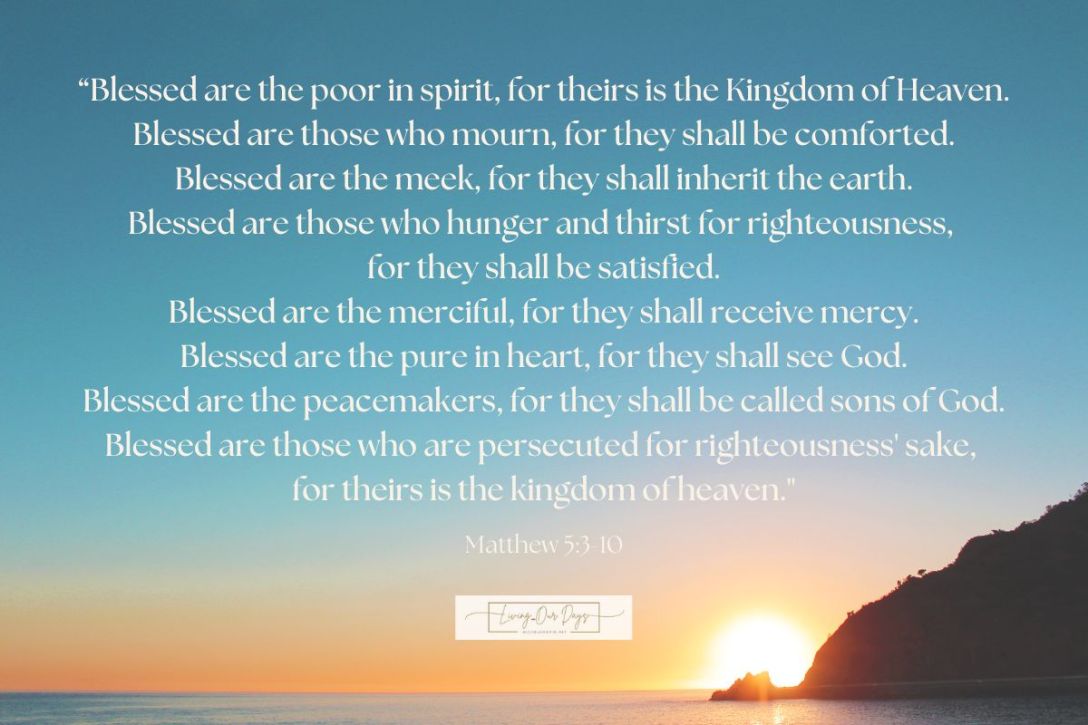
Blessed are the poor in spirit, for theirs is the Kingdom of Heaven.
Matthew 5:3-10
Blessed are those who mourn, for they shall be comforted.
Blessed are the meek, for they shall inherit the earth.
Blessed are those who hunger and thirst for righteousness, for they shall be satisfied.
Blessed are the merciful, for they shall receive mercy.
Blessed are the pure in heart, for they shall see God.
Blessed are the peacemakers, for they shall be called sons of God.
Blessed are those who are persecuted for righteousness’ sake, for theirs is the kingdom of heaven.”
I find myself lacking in every quality defined here, and if I thought I had to produce meekness and mercy in sufficient quantities to merit divine favor, I might be tempted to give up in despair!
But…
What if the Beatitudes are not prescriptive, but rather descriptive?
What if instead of reading them as a list of impossible expectations I began to understand them as a way of life that begins to manifest itself in the person who is daily and consistently “presenting herself as a living sacrifice to God,” who embraces the truth that we don’t earn God’s favor or become worthy of his love by making peace or showing mercy.
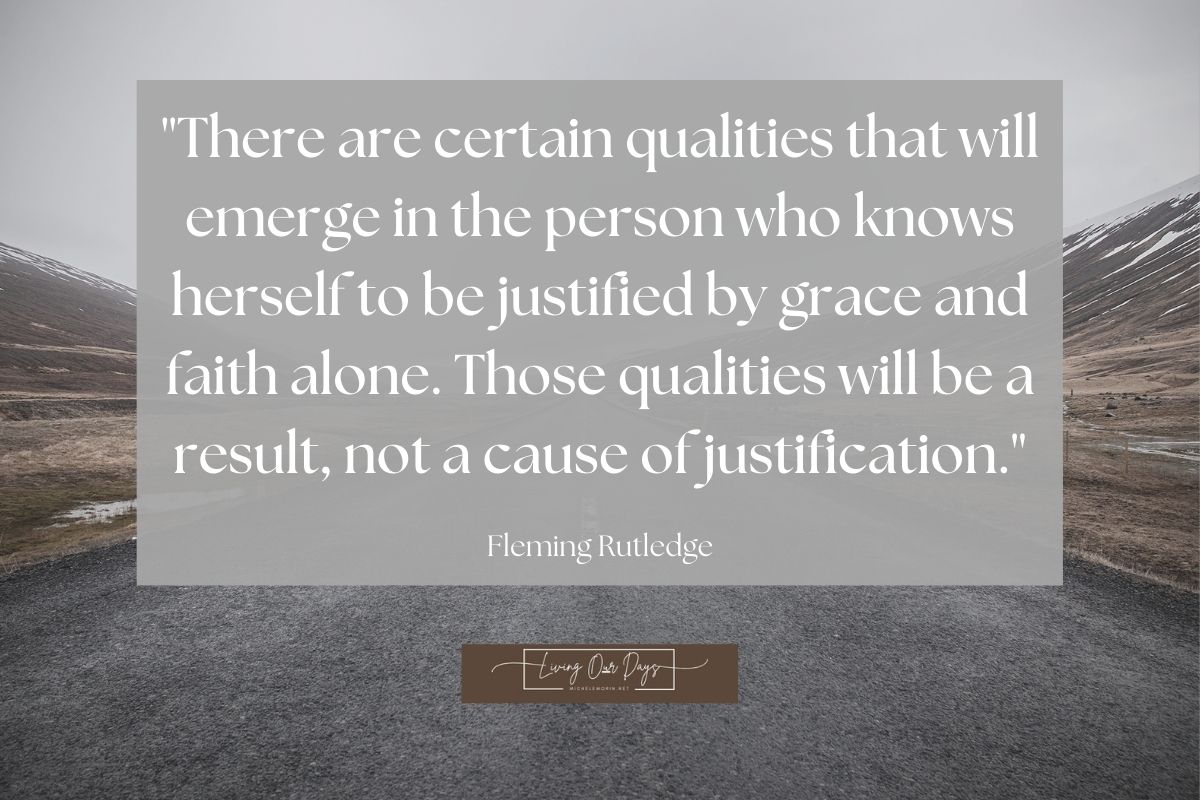
“There are certain qualities that will emerge in the person who knows herself to be justified by grace and faith alone. Those qualities will be a result not a cause of justification.” Fleming Rutledge in Epiphany @ivpress @flemingrut
Tweet
Fleming Rutledge sums it up beautifully and theologically: ”There are certain qualities that will emerge in the person who knows herself to be justified by grace and faith alone. Those qualities will be a result, not a cause of justification.”
Naturally, this doesn’t let me off the hook or excuse sloppy, impure, or blustery living. The difference is motive. (Isn’t it always?) We lean into habits of holiness because we are already mightily loved by God—not because we expect to earn God’s approval through them.
Therefore, we receive the Beatitudes and the descriptions of righteousness in the Sermon on the Mount that “exceed that of the scribes and Pharisees” with the knowledge that the same grace that transported us into the kingdom of God is still at work in us, creating actual, visible holiness. Knowing this, the “Blessed are YOU” becomes an even greater benediction.
Thanks be to God, we are products of grace.
Because of Jesus, we are recipients of grace.
By the Spirit, we are conduits of grace.
We shall be comforted, we shall inherit the earth, we shall be satisfied, ours is the kingdom of heaven, we shall receive mercy, we shall see God, we shall be called sons of God.
The Kingdom of Heaven is ours.
Resource: Epiphany: The Season of Glory by Fleming Rutledge (InterVarsity Press, 2023).
Holding You in the Light,

Thanks be to God, we are products of grace. Because of Jesus, we are recipients of grace. By the Spirit, we are conduits of grace.
Tweet
A New Bible Study Plan on YouVersion
I’ve created a 13-part study that gives you an overview of The Epistle to the Hebrews, a letter to a congregation of struggling Jewish Christians written by an unknown author sometime before the destruction of Jerusalem in 70 A.D. We will be landing on a few verses in each chapter with the goal of big-picture familiarity, as opposed to mastery of this fascinating and complex book. CLICK HERE to go directly to the plan on the YouVersion site or find it on the app.
Free Encouragement in Your Inbox!
On the third Thursday of every month, I send a newsletter with biblical encouragement straight to my subscribers’ email inboxes. Frequently, I share free resources, and the newsletter is where everything lands first. I’m committed to the truth that women can become confident followers of God and students of his Word, and it’s my goal to help you along that path.
To add this free resource to your pursuit of biblical literacy, simply CLICK HERE. There, on Substack’s website, you’ll find a prompt that looks just like this image for Living Our Days with Michele Morin. Over on that site, simply enter your email and then click on the purple “SUBSCRIBE” button.
You’ll receive a welcome letter to confirm your subscription and monthly encouragement in your email inbox.

I am a participant in the Amazon Services LLC Associates Program, an advertising program designed to provide a means for sites to earn advertising fees. If you should decide to purchase any of the books or products I’ve shared, simply click on the image, and you’ll be taken directly to the seller. If you decide to buy, I’ll receive a few pennies at no extra cost to you.


 Living Our Days
Our church just went through Matthew, and this was our takeaway. What good news for those who are truly His by grace alone, by faith alone.
LikeLike
It does lift the burden of sanctification, emphasizing the partnership with God in our growing holiness.
LikeLiked by 1 person
I loved your article on Desiring God today. Thank you for your faithfulness to share what God is showing you.
LikeLike
A week or two ago, I came across a quote in my files I had saved from one of Sue Donaldson’s posts: “I don’t worship habits, but habits help me worship.” I don’t know why we’re so prone to legalism or to checking off boxes instead of resting in Christ’s righteousness on our behalf. But it takes frequent reminding that I don’t drum up my own righteousness by doing right things (even if I could). “My hope is built on nothing less than Jesus’ blood and righteousness.”
I like that perspective of thinking of the Beatitudes as something that we’ll grow into more and more as we walk with the Lord.
LikeLike
That’s a great quote! I also have a tendency to get the cart before the horse when it comes to this business of sanctification. I need frequent reminders that nothing I do can make God love me more–or less!
LikeLike
Another ultra-meaningful, post, Michele. I loved this: “Thanks be to God, we are products of grace. Because of Jesus, we are recipients of grace. By the Spirit, we are conduits of grace.” Those are profound truths to shout-for-joy from the rooftops! Also, thank you for your gentle encouragement to “lean into habits of holiness because we are already mightily loved by God—not because we expect to earn God’s approval through them.” AMEN, my friend!
LikeLike
Standing on the rooftop with you, Nancy!
And definitely trusting for grace to keep on leaning into grace.
LikeLiked by 1 person
I once heard a gentleman give a children’s message in which he said, “We do things for the Lord because He loves us; not to get Him to love us. I have a very important prayer request I want to share with you, PLEASE PRAY for my pastor, Pastor Rick Jones and his wife, Cheryl, Pastor Rick has suffered a mild stroke. This coming Sunday, a gentleman from our congregation will bring a message. On February 11, we will have an interim pastor taking charge of the service. Please pray for our church and for the pastor’s family. We are trusting God to get us all through this circumstance. Thank you in advance.
LikeLike
Praying right now, friend.
Trusting for healing!
LikeLike
This is a helpful guide, Michele, lest we think we can somehow earn our way into holiness. May we grow more deeper in love with our Savior and more eager to live a life that glorifies Him.
LikeLike
It’s such a subtle thing–God is not opposed to effort, but we definitely need to keep our mindset away from earning our way into his heart. How wonderful that we already abide there because of his forgiveness and his faithful love.
LikeLike
Thank you, Michele for the reminder that we are saved by “grace” not works. And no amount of crossing “t’s” and dotting “i’s” will keep us in good standing with God!
LikeLike
We all long for the control and the power trip of a Pharisaical faith. When will we learn that God doesn’t want our work or our performance? He wants our hearts!
LikeLiked by 1 person
This is a much needed read for me. I love that you always have me looking from different angles and sometimes even leading me to look outside of the box. Your teaching really helps my learning of Jesus mature.
Thanks bunches and bunches for sharing this wonderful lesson with Sweet Tea & Friends this month dear friend.
LikeLiked by 1 person
That’s the kindest thing you could ever say to me, Paula! Thank you so much for reading with an open heart.
LikeLike