One of the most frequent questions I’ve been asked over the years (and one I struggled with myself as a young woman) is this: ”I know I’m supposed to be having a devotional time with God every day. What does that look like?” The short answer is that there’s no short answer to that question!
My own devotional practices have changed over the years. What I do and how it would look to a casual observer may be different from day to day!
The “experts” are all over the map with their advice:
- “Meet with God first thing in the morning to start your day out right.”
- “Read your Bible and pray before you go to bed so you can end your day with Jesus.”
- “Never use devotional books! “
- “Be sure to plug into a good devotional to guide your thinking about the Bible.”
- “Keep your teaching material and your personal study separate.”
- “Incorporate your teaching topics into your devotional time so you’re truly saturated in the text.”
As with most polarized opinions, likely, the real truth lies somewhere in the middle, so rather than trying to locate a sweet spot that will work for everyone (P.S. It doesn’t exist), I’ll share a short list of components for a meaningful and rich devotional life.
What You Need…
- Bring your Bible
There’s nothing wrong with My Utmost for His Highest or the devotional works of Charles Spurgeon or Andrew Murray—or anyone else for that matter as long as they are orthodox. (I’ll be recommending a devotional book in this post!)
However, devotional writers are not inspired or infallible, so devotional books should never take the place of your Bible. God the Holy Spirit uses the truth of scripture to speak directly to our lives and situations. Learning the patience of sitting with the sacred text is part of our growth in godliness.
So… even though it’s easier and seems more efficient to gulp down a page from a devotional book and then move on, make the better choice of holding yourself before the “living and active” Word of God every day. - Talk to God
I’m intrigued by the way Eugene Peterson talked about prayer: “Prayer detached from Scripture, from listening to God, disconnected from God’s words to us, short-circuits the relational language that is prayer.”1 This unshackles me from my tendency to come to prayer as if I’m handing a to-do list to God. It invites me to ask myself, “What does God want me to be asking for?”
Whether you keep detailed lists of alphabetized missionary prayer requests arranged by the days of the week or simply open your heart to God with the day’s most pressing needs, bear in mind that prayer is first and foremost a conversation. Be sure to leave time and space to listen. - A Way to Worship
Right now I’m toting a hymnal along with my devotional resources, allowing the words to remind me of God’s greatness. Sometimes I’ve used Israel’s hymnal, the book of Psalms for this purpose, praying a psalm back to God. Maybe you prefer to listen to music or take a walk in God’s beautiful world to help you find your way to worship. - A Way to Remember
I record observations and notes from my reading and listening, prayer requests (and sometimes answers to prayer!), and anything that inspires or challenges me in a simple journal. Pen and paper have always been my most comfortable medium. That’s slowly changing as Parkinson’s disease makes handwriting more difficult, but even this is a gift, because it gives me empathy for others who just aren’t wired like me and see writing as a chore and not a lifegiving outlet.
I’ve started exploring alternatives to paper and pen, and maybe you’d be more comfortable with a Word document or the Notes app on your phone? I recently loaded the Obsidian app and may begin experimenting with that. The key is to keep a record so you will remember your encounters with God when they happen. - Reasonable Expectations
Bear in mind that none of the above preparations will result in a daily fireworks show. We “see through a glass, darkly.” We are dust, and we flourish “as a flower of the field.” Our daily routine of meeting with God will not likely involve skywriting or an audible voice.
Over time, though, spiritual practices will lead to growth in our ability to recognize God’s voice when it comes to us in his Word, by his Spirit. Our relationship with God will grow in depth as his track record of faithfully meeting with us teaches us to grow in faith.
I’m curious…
What devotional practices have been most meaningful for you?
What has been the most difficult?
What questions do you carry that we could discuss here together?
1Eat this Book, Eugene Peterson, (Eerdman’s, 2009), page 104.
Devotional writers are not inspired or infallible, so devotional books should never take the place of your Bible. Hold yourself before the “living and active” Word of God every day.
Tweet
And Now Let’s Talk Books…
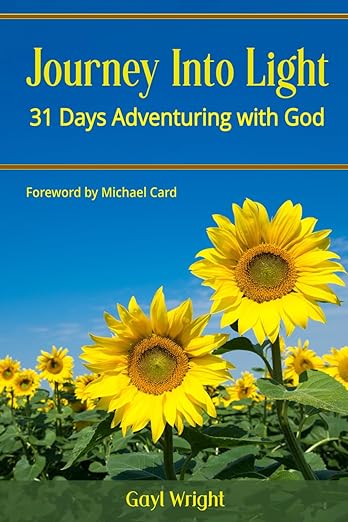
Gayl Wright shares that Journey Into Light was fueled by years of living with God as her guide. In each devotional entry, she spotlights one word, and then poetry creates an unwavering path to Scripture. Her own story of lived faithfulness provides abundant material for interpretation, turning her readers’ hearts toward the task of skillful application of the truth. Thoughtfully worded prayers prompt a pause that leads to reflection on Gayl’s insightful closing questions.
With thirty-one entries, Journey Into Light is a launch pad to a habit of regular time with God and an invitation to a life filled with wonder and gratitude—a life of worship. And there’s bonus content! I was surprised to find a half dozen of Gayl’s crochet patterns at the end of the book! Maybe this is the push I need to learn the art of crocheting!
Gayl’s publisher, Chronic Joy Publications, provides resources ranging from free printables to full-length devotionals as they compassionately serve those affected by chronic illness.
And on a side note, Gayl is one of the few online friends I have actually had the privilege of meeting in person. Over towering slices of pie, we got acquainted at Moody’s Diner when her family was vacationing here in Maine.
Holding You in the Light,

Journey Into Light by @GaylWright is a launch pad to a habit of regular time with God and an invitation to a life filled with wonder and gratitude—a life of worship. @ChronicJoyMin
Tweet
Looking for Challenging Devotional Reading that Encourages You to Seek Intimacy with God Every Day?

As you know, I’m committed to the truth that women can become confident followers of God and students of his Word, and it’s my goal to help you along that path. At Living Our Days, I provide biblical content and resources to encourage biblical literacy and faithful living, and now I’m sharing devotional content on the YouVersion app. Visit my profile page to get free access to the reading plans!
Free Encouragement in Your Inbox!
On the third Thursday of every month, I send a newsletter with biblical encouragement straight to my subscribers’ email inboxes. Frequently, I share free resources, and the newsletter is where everything lands first. I’m committed to the truth that women can become confident followers of God and students of his Word, and I want to help you along that path.
To add this free resource to your pursuit of biblical literacy, simply CLICK HERE. There, on Substack’s website, you’ll find a prompt that looks just like this image for Living Our Days with Michele Morin. Over on that site, simply enter your email and then click on the purple “SUBSCRIBE” button.
You’ll receive a welcome letter to confirm your subscription and monthly encouragement in your email inbox.

I am a participant in the Amazon Services LLC Associates Program, an advertising program designed to provide a means for sites to earn advertising fees. If you should decide to purchase any of the books or products I’ve shared, simply click on the image, and you’ll be taken directly to the seller. If you decide to buy, I’ll receive a few pennies at no extra cost to you.
Photo by Debby Hudson on Unsplash


 Living Our Days
My first thought – my answer will be too long – just don’t. Then I remembered that my answer includes the reality that I am a conduit, a partner in God’s plan to open eyes. So, here it is – my experience.
My first recollection of talking to God was from about age six. I used my quiet time, swinging, pumping with all my strength, trying to touch the lowest branch of the pine tree that towered above my swing set. I knew He was there, listening. I don’t know how I knew, but I did.
Somehow this knowledge became the basis for my desire for a One on one relationship. Even in my hectic years, mothering three kids and trying to survive, I never had a need to set a particular time aside in my day because I was constantly communicating all day. I came to think of this as praying without ceasing. He is always with me because I acknowledge that He is. I give him credit with all gratitude for everything, big and tiny, that forms my life.
If I wake up in the middle of the night, burdened to pray, I don’t always know why and I don’t ask for what, I say the Lord’s prayer, I grant the Holy Spirit to speak in my cleared mind. Then I go to sleep, rarely knowing what the petition was for.
We are all wonderfully and differently made and I can freely admit, the way I have to do things is rarely considered normal and therefore hardly ever for anyone else. But, for me, 76 years in, it’s hard to argue with success. I can recommend that the single most important part of devotion is to begin and end with gratitude.
LikeLiked by 1 person
Begin and end with gratitude! Yes!
And I love that image of communion with God on a swing. That seems right to me and makes me wonder if the old swing hanging in my front yard has been the site of some holy moments!
Thank you for taking the time to go deep with this comment.
LikeLike
HUGS! 🙂
LikeLike
Very well written. I resonate with this post. I enjoy reading devotionals, but I prefer (at least have a spiritual hunger and curiosity) to read the bible first. And let us read it daily morning, night, and between the day. Jesus never stopped praying because “life is busy.” He sought the Lord to demonstrate that we cannot make any moves, decisions, or plans without first checking in with God. That’s why the expert got it wrong. Everyone has many excuses why there’s no time to devote to God. But when we need something from God, we find time to ask/pray. We can give God time to request something from us—obedience to read His word daily.
LikeLike
Such a great point–and the busier Jesus was, the more he realized his need to pray! May we follow his example and take his help!
LikeLiked by 1 person
Amen
LikeLiked by 1 person
Wonderful suggestions. I find my way of connecting changes with the seasons of my life. But some anchors stay the same.
LikeLike
Thank you for these tips. There is no right or wrong for using a devotional but I’m thankful that you pointed out the need to focus on the truth of the Word of God. I’m using New Morning Mercies by Paul David Tripp this year. He always suggests scriptures to read each day to go deeper. I love it.
LikeLike
I once heard the answer to the question about the right devotional way as: “The right way is the way that works for you!” I liked that. We all have different needs and schedules. The idea is to find what will grow our walk with God and give us deep roots in His Word. My time in the morning now looks way different than it did when my children were home. I want to get better at journaling my thoughts on paper each morning. Glad you mentioned it!
LikeLike
God is so much more relational than we usually realize. We’re looking for a formula when what he offers to us is the gift of himself!
LikeLike
The book I am trying to write is on this topic, so I would have a lot to say. 🙂 I agree very much that what we do can change with different days or seasons of life. And the fact that devotional books can be good supplements but shouldn’t be the main course. And that we should have reasonable expectations, and that every devotional time won’t be fireworks or warm fuzzies. I like to say that every meal nourishes me, though some meals or more enjoyable and memorable than others. So it is with our time with the Lord. Each time will nourish us spiritually, even if there’s not a new insight or special feeling afterward.
One of the most important things I have to continually remind myself is that our devotional time should be relational–communicating with our God, getting to know Him better–not just an exercise.
LikeLiked by 1 person
Worthy additions here to Michele’s post, Barbara. I’m glad you’re working on that book!
LikeLiked by 1 person
Thanks so much, Nancy. I wish I could put aside everything else and just work on the book for a few weeks. 🙂
LikeLiked by 1 person
I wish you could too, Barbara! (Lord, You’re the only One who can make that happen. I pray you would free up hours each day for her to achieve this goal of a completed book!)
LikeLiked by 2 people
Good points! I think if we treat God as what He is, a real living Person, who wants to have a relationship and dialogue with us, it helps quite a lot and takes the focus off the “how” to do devotions. He’ll meet us each where we are.
LikeLike
Those five components of a rich and meaningful devotional life are spot-on, Michele! My quiet time (first thing in the morning) generally includes four elements: Bible study, journaling, scripture memorization, and worship/prayer. This time set aside to be with my Heavenly Father is my favorite time of day!
LikeLiked by 1 person
I appreciate your balanced and insightful approach to a devotional time with God. As one who writes devotions for publication, I really appreciated your encouragement to not depend on those for our main quiet time. I always tell people that reading their Bibles needs to come first! I also appreciated your encouragement to leave time to listen to god when praying. I’m afraid I’m not so good about doing that, though often God will help me with insights throughout a day ! My prayers are with you as you work to find ways to keep writing. for different reasons, I also have trouble with that so I’ll be interested to hear about your experience with Obsidian. Dragon Speak used to be helpful for me, but the newer version has been frustrating.
LikeLike
Somehow this comment ended up in the spam bucket! I’m glad to have found it because you raise so many good points. That discipline of quiet listening doesn’t come easily, does it, but I see that it adds a dimension to prayer that keeps it from being a recitation of my “do list” for God!
LikeLike
Michele, thank you so much for sharing my book. I do hope that it will encourage others on their walk with the Lord. I love your 5 tips for our devotional times. The Word is so very important because, without it, we won’t really know God the way He wants to be known. It may seem daunting at first, but the more I spend time in the Word, the more I am drawn to it. One practice I did for many years, and I may start it again, is reading and responding to the Psalms every day with a prayer or poem or some type of art. That practice carried me through the initial time of grief when we lost our son and reminded me that we will see him again. Also, it’s interesting that you mentioned the line, “…through a glass, darkly.” That’s the title of my new book on hope. I’m in the process of looking for a publisher or doing it myself. The full title is Through a Glass, Darkly: Daily Hope in Light of Eternity. Thanks so much for your faithfulness in sharing the Word and pointing us to God. May He bless you richly as you continue through life and as you navigate this Parkinson’s disease. Love and hugs to you! xoxo I loved meeting you that time in Maine!
LikeLike
[…] What Makes for a Rich and Meaningful Devotional Life? “One of the most frequent questions I’ve been asked over the years (and one I struggled with myself as a young woman) is this: ’I know I’m supposed to be having a devotional time with God every day. What does that look like?’ The short answer is that there’s no short answer to that question!” […]
LikeLike
Michele, I was just thinking about ‘reasonable expectations’ this morning while out walking, more pertaining to getting fresh air and exercise but then it spilt over into other areas of my life that I want to be non-negotiable. So to find your wise cautions here lets me know I’m headed in the right direction. Reasonable and doable trumps perfectionistic and unattainable any day of the week. Thank you for this message of grace.
Sabbath blessings to you, friend.
LikeLike
Glad it spoke to you, Linda. I just know I spent a lot of time in my younger years trying to model my devotional life after people I looked up to—and who happened also to be childless, much older, and in a completely different phase of life.
LikeLike
In answer to your question, Michele, I find writing out my prayers helps me when I seem stuck or disconnected in time with God. But several of the things you mentioned really spoke to me this morning.
LikeLike
I kept a prayer journal as a young woman, wrote out every word—it was life altering!
LikeLike