In declaring war against evil, it’s the thoughts, the ordinary workings of our mind, that send us veering off course. These are the thoughts of one ordinary Christian woman in the twenty-minute drive home from church on an ordinary Sunday:
She stews over a comment made during the meet-and-greet and plans a subtle stab for next week.
She anticipates her family’s response to the dinner menu and slides into self-pity, but not before thinking less of her husband for not taking the whole family to a restaurant.
She reviews her friends’ clothing choices alternating between jealousy and judgment.
She brainstorms major points for next week’s study, considering how she can make it better than Barbara’s from last week.
And if you were to intercept the lady as she gathers Bible, tote bag, and pocketbook from her minivan and inquire about what she had been pondering on the drive home, she would have answered, “Oh, nothing much.”
In this seemingly banal way, evil finds its way into the believer, and naturally, therefore, into the church.
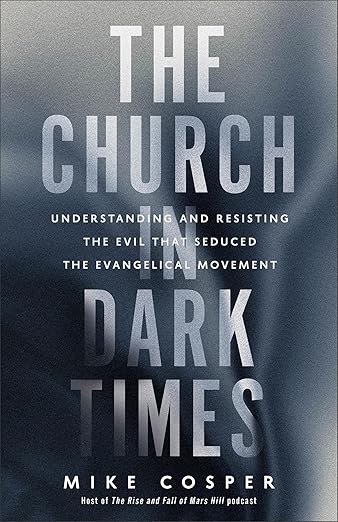
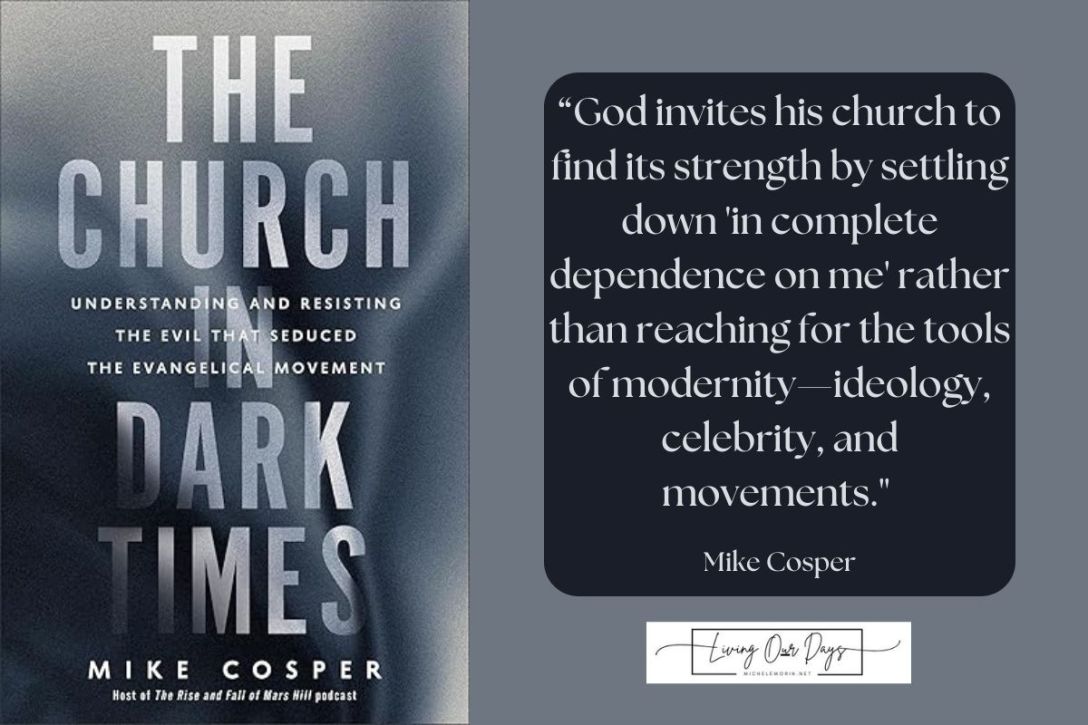
The Church in Dark Times offers Mike Cosper’s insights on the seduction of evil and the failures of the modern evangelical movement, a timely follow-up to the conversation begun in The Rise and Fall of Mars Hill podcast.
Evil in the church can be surprisingly thoughtless. It often walks through the church’s front door dressed as recognition or prestige. Good people may support deeply flawed ideas or participate in the mistreatment of fellow church members and consider it “all in a day’s work,” a necessary and banal part of reaching a stated goal.
I especially appreciated Cosper’s enlightening references to the thinking of Hannah Arendt, the 20th-century political theorist best known for her observation about the “banality of evil.” Oppressed by Nazi antisemitism in the 1930s, she immersed herself in questioning the existence of so much evil. That’s a valid question for the church in an era characterized by abuse and cover-ups, narcissism and moral failure, toxic leadership and distorted ethical frameworks.
Resisting the Tools of Modernity
Having lived through “dark times” in Western Europe, Arendt traced the moral failure of murderous antisemitism to ideology, which she defines as a story that accounts for “all that has happened in the past, the struggles of the present, and the promise of a utopian future.” The ideology of a dysfunctional church excuses bad behavior or unbiblical thinking in the interest of the church’s mission or the protection of the stellar ministry of a stand-out church leader.
It’s easy to fall into the trap of momentum and enthusiastic groupthink around the idea that “this church” or “this talented pastor” is somehow necessary to God’s kingdom advancing, and this is where Cosper sounds the alarm:
God invites his church to find its strength by settling down ‘in complete dependence on me’ rather than reaching for the tools of modernity—ideology, celebrity, and movements.”
Cosper prescribes practices of solitude, storytelling, culture-making, and worship as safeguards against the siren call of evil. Alone with God and our own conscience, we discover our convictions and measure our actions against our values. Then armed with a clear vision of what it means to be a Christian, we act and speak in ways that impact culture for good. For me, this has led to writing and teaching, but for some of my favorite people, it means helping in their church’s youth ministry or making frequent trips to the hospital to comfort and encourage friends. Our work becomes our worship, and “worship always invites us into something larger than ourselves.”
If you’ve spent any time at all participating in the life of a church family, it goes without saying that you’re carrying some hurt, some regret, or even some downright erroneous teaching. In church, we are thrown in with a group of people we did not necessarily select, and are given the command to love and to serve one another. At times we follow leaders who seem to have lost their compass.
Church has been the influence that has pushed me, challenged me to a greater faithfulness, and stretched me outside my comfort zone. It has also been the pebble in my shoe, the sandpaper that has knocked off some of my rough edges. There’s no doubt about it: Church can be difficult. Even so, the church is God’s gift to us, and we need one another with all our rich harmonies of expression to sing the beauty of God, which is infinitely more than one of us could ever express with our own small voice.
The church is God’s gift to us, and we need one another with all our rich harmonies of expression to sing the beauty of God, which is infinitely more than one of us could ever express with our own small voice.
Tweet
What Other Reviewers Are Saying
“…this book shows a way forward without wish-casting or spin, but honest, repentent, cross-shaped hope.” ~Russell Moore, editor in chief, Christianity Today
“Seeing viable and compelling ways forward will illuminate even this much darkness. This is what Mike Cosper offers in these pages.” ~Karen Swallow Prior, author of The Evangelical Imagination
Holding You in the Light,

In #TheChurchinDarkTimes, @MikeCosper prescribes practices of solitude, storytelling, culture-making, and worship as safeguards against the siren call of evil. @BrazosPress
Tweet

Free Encouragement in Your Inbox!
On the third Thursday of every month, I send a newsletter with biblical encouragement straight to my subscribers’ email inboxes. Frequently, I share free resources, and the newsletter is where everything lands first.
CLICK HERE to read my most recent newsletter where you’ll be given the opportunity to subscribe. I’m committed to the truth that women can become confident followers of God and students of his Word, and I want to help you along that path.
Looking for Challenging Devotional Reading that Encourages You to Seek Intimacy with God Every Day?

As you know, I’m committed to the truth that women can become confident followers of God and students of his Word, and it’s my goal to help you along that path. At Living Our Days, I provide biblical content and resources to encourage biblical literacy and faithful living, and now I’m sharing devotional content on the YouVersion app. Visit my profile page to get free access to the reading plans!
I participate in the Amazon Services LLC Associates Program, an advertising program designed to provide a means for sites to earn advertising fees. If you should decide to purchase any of the books or products I’ve shared, simply click on the book title, and you’ll be taken directly to the seller. If you decide to buy, I’ll receive a few pennies at no extra cost to you.
Many thanks to Brazos Press and NetGalley for providing a copy of this book to facilitate my review, which is, of course, offered freely and with honesty.


 Living Our Days
Wow. ‘the pebble in my shoe, the sandpaper that has knocked off some of my rough edges.’
This has come at the right time for me. No need to say more.
LikeLike
That process of refinement isn’t for cowards, is it?
LikeLike
Adding this book to my read list, thanks for sharing!!
LikeLike
Great! I hope it’s a challeging read for you, too!
LikeLike
“Church has been the influence that has pushed me, challenged me to a greater faithfulness, and stretched me outside my comfort zone.” This means that church has pushed me to grow my faith and trust in God. Now that I have typed that sentence, I realize something. Both my family and my church family have been the avenues that God brought about change and growth in my life. Interesting that “family” is where He chooses to do so.
LikeLike
I’ve noticed the same thing, Joanne. Imagine how hard it would be to believe that we need a savior if we didn’t have to relate to the people who know how to push our buttons?
LikeLike
Evil is so subtle, we don’t recognize it in our discontent and comparisons and seemingly innocent thoughts. How we need the Holy Spirit’s convictions along with soft hearts to listen and respond.
LikeLike
You are SO right!
LikeLiked by 1 person
Mike Cosper’s book sounds full of valuable insight. The enemy is so clever, able to insinuate evil into our midst without us even being aware. We need our one-on-one time with God so he can expose the little foxes (Song of Solomon 2:15) that want to create mischief, and we need one another in the family of God to encourage, exhort, and hold one another accountable. May we indeed settle down in complete dependence on him. Thank you, Michele!
LikeLike
Cosper is a realist, and his experience and research could have made him a cynic, but I didn’t get the vibe as the loudest thing coming through in the book. As Eugene Peterson said, “Sooner or later we have to deal with the church. I say sooner.”
And I say “sooner” too!
LikeLike
I was just watching a “report” about Mars Hill at lunch today, Michele. There is currently a lot of exposure in the church which I think is good. If the curtain can be pulled back and we see evil and not good, it needs to be exposed. In the midst of the exposure, we need to keep our hearts in a good place, seeking for Christ to be honored, the church made stronger, and those wounded to begin their healing process. And your statement, “Church can be difficult. Even so, the church is God’s gift to us.” Is so true.
LikeLike
It’s a delicate balance, isn’t it ?
We have to love the church enough to expose evil AND to continue our commitment to the Body of Christ. It makes me sad when people give up on the church.
LikeLiked by 1 person
Sounds like an interesting and timely book. What a reminder that we ultimately need to spend time with God and in His word. Romans 12:2 reminds us to renew our minds so that we will be able better understand God’s will. This is so important because it’s easy to fall into wrong patterns of thinking and be influenced by others. Thanks for sharing!
LikeLike
Yes, sticking close to truth, knowing what the Bible says for ourselves, helps us to be more discerning.
Thanks for reading!
LikeLiked by 1 person