Little boys don’t just magically start hanging up their tiny jackets when they walk through the door. They have to be taught that this is how civilized people live and move through life, and in the spring of 1996, this was front and center in the Morin household. Our son had his very own hook in the closet, at toddler height, where he was to hang his jacket instead of dropping it on the floor.
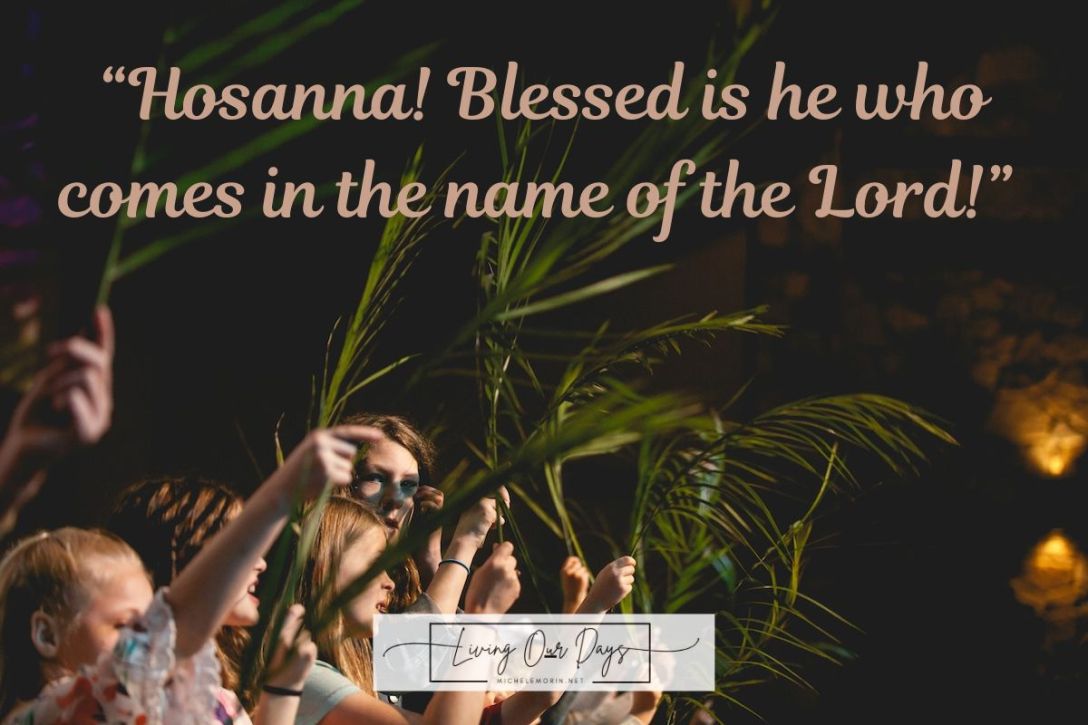
Against this backdrop, family devotions centered on Holy Week, beginning with the Triumphal Entry, when Jesus rode into Jerusalem on a donkey’s back and was greeted by crowds who spread leafy branches and threw their cloaks on the road before him (Mark 11:8). When we asked our young son why the people did that, his automatic reply was, “Because they didn’t have any hooks.”
A behavior that signalled submission and reverence in one culture looked like disobedience or sloppiness to the mind of a toddler, which drives home the importance of motive. Exactly what was going on in everyone’s minds that day?
What Jesus Was Thinking
Like everything Jesus said or did, his motive for the Triumphal Entry was the fulfillment of God’s redemptive plan. Bit by bit, he whittled away at the Old Testament prophecies about the Messiah, and this particular scenario was foretold in Zechariah 9:9: “Rejoice greatly, O daughter of Zion! Shout aloud, O daughter of Jerusalem! Behold, your king is coming to you; righteous and having salvation is he, humble and mounted on a donkey, on a colt, the foal of a donkey.”
As he so often did, Jesus makes us do a double-take, accepting praise when he usually shunned the limelight, entering the city astride a donkey when he usually walked, and then weeping over a city that had turned out to celebrate his arrival. Jesus was well aware that his physical body would not leave Jerusalem alive.
On Palm Sunday, Jesus makes us do a double-take, accepting praise when he usually shunned the limelight, entering the city astride a donkey when he usually walked, and weeping over a city that had turned out to celebrate his arrival.
Tweet
What the Average Israelite Was Thinking
Mark’s account of the story has the crowd shouting, “Hosanna! Blessed is he who comes in the name of the Lord! Blessed is the coming kingdom of our father David! Hosanna in the highest!” Word of Jesus’s miracles and his wise teaching had filled their hearts with hope that he was, indeed, the Messiah, and they were ready for deliverance.
But deliverance from what? We know that even the disciples had muddled thinking about Jesus’s purpose and their role in “his kingdom.” Sadly, the crowd’s “Hosannas” were a cry for Jesus to save them from Rome—not from their sins.
What the Religious Elite Were Thinking
The Pharisees in the crowd that day would likely have been present when Jesus spoke prophetically over the city of Jerusalem that “you will not see me until you say, ‘Blessed is he who comes in the name of the Lord!'” (Luke 13:35) They would have been connecting the dots, remembering Jesus’s bold claims, the accounts of Jesus’s calling Lazarus from the tomb, and then looking at the earnest faces lining the street. They may have been angry, jealous, or fearful, but scripture tells us they were paying attention, for “the Pharisees said to one another, ‘You see that you are gaining nothing. Look, the world has gone after him’” (John 12:19).
The Tragedy of Misunderstanding
Because we know how the story ends, Palm Sunday comes to us with an undercurrent of ambivalence. The whiff of triumph from that assembled crowd turns ugly, and in just a few days, adulation becomes accusation. Jesus was abandoned by his closest friends and then publicly executed.
It looked as if everyone had been wrong about who Jesus was and what he had come to do.
They were.
Most of Jesus’s closest friends didn’t put the pieces together until sometime after the resurrection.
And even today, we get it wrong—despite our privileged knowledge of biblical history, the apostles’ vivid explanation of the Gospels’ narrative, and the Holy Spirit’s faithful translation in our redeemed hearts and minds.
What kind of a Messiah are you looking for?
At the beginning of Holy Week, let’s reaffirm the truth that Jesus did not come to give us an exemption from the trials of this world. He did not promise political power or success in this life. What he did promise has to do with another world altogether.
“Hosanna! Blessed is he who comes in the name of the Lord, even the King of Israel!”
Holding You in the Light,

On Palm Sunday, we affirm the truth that Jesus didn’t come to give us an exemption from the trials of this world. He didn’t promise political power or success in this life. What he did promise has to do with another world altogether.
Tweet
A New YouVersion Plan for Lent and Easter!
As you know, I’m committed to the truth that women can become confident followers of God and students of his Word, and it’s my goal to help you along that path. At Living Our Days, I provide biblical content and resources to encourage biblical literacy and faithful living, and now I’m sharing devotional content on the YouVersion app. Visit my profile page to get free access to all the reading plans!
Have You Read the Latest Newsletter?
On the third Wednesday of every month, I send a newsletter with biblical encouragement straight to my subscribers’ email inboxes. Frequently, I share free resources, and the newsletter is where all the news lands first.
CLICK HERE to find me on Substack, where my goal is to help you on the path of becoming a confident follower of God and a student of His Word.
Disclosure: I am an Amazon Associate, which means that whenever you purchase a book I’ve shared here through the link I provide, I’ll receive a very small commission. It doesn’t cost you more, and I only share books here that I can wholeheartedly recommend.
Photo by Zach Lucero on Unsplash


 Living Our Days