Having arrived and having now spent a few years in the season of the empty nest, I feel qualified to report on my findings. You may be surprised…
I think we’re always surprised when the good we anticipate turns out to be hard. Understand, I’m not saying that good and hard are opposites. However, in the days of raising and homeschooling four sons, when I was scaling Mount Laundry every day and meal-planning like Hannibal crossing the Alps, I would sometimes try to picture a world that didn’t revolve around full-time parenting. In that world, I would learn to play the piano. I would drink my tea when it was hot—and even have time for a second cup as I spent hours reading and writing. I would manicure my immaculate garden and serve as an ESL tutor or a library volunteer.
That energetic thirty-something-year-old woman doesn’t live here anymore. She has been replaced by a sixty-something-year-old woman with a degenerative neurological disease, eight grandchildren, and a part-time job. This is a wonderful season of life. And it is also a weary season.
It encourages me to read that Paul must have experienced weariness in the course of his busy life. He wrote, “And let us not grow weary of doing good, for in due season we will reap, if we do not give up” (Galatians 6:9). He had discovered that in the course of “doing good,” we might find ourselves losing interest, experiencing fatigue, or encountering obstacles that tempt us to quit. And then he shares the simple (but not easy) remedy for weariness: Don’t give up!
I think we’re always surprised when the good we anticipate turns out to be hard. Understand, I’m not saying that good and hard are opposites.
Tweet
What Grows in Weary Lands?
Tish Harrison Warren is one of my favorite writers on spiritual formation, and she also encountered a season of intense and unexpected weariness. She had written for The New York Times for nearly two years, her dream job, meeting deadlines and writing about issues that were important to her. Suddenly, writing became a chore, family responsibilities became overwhelming, and, worst of all, God seemed distant and uncommunicative.
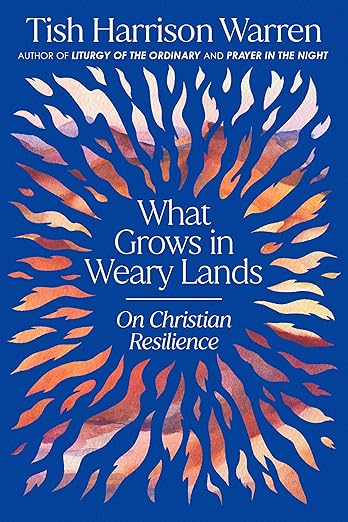
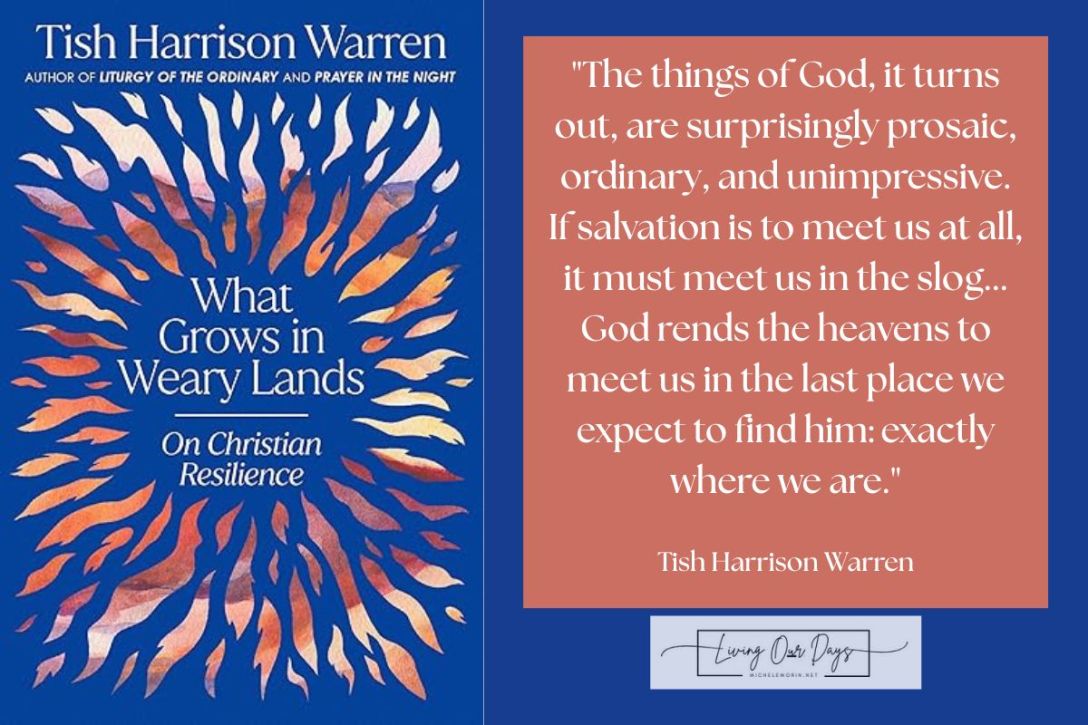
She discovered that her weariness was not unique to the 21st century. Christians have been writing about it for centuries, often referring to it as acedia or the dark night. Historic Christians became Warren’s path back to flourishing, not because life got easier, but because her perspective changed. She found that “the holiest people in Christianity’s history… have returned, again and again, to a common question: How do you keep going?” What Grows in Weary Lands is the fruit of her own earnest seeking.
Chapter titles frame the book’s message in the language of the early church fathers and mothers who mentored their students and apprentices with phrases like “stay in your cell” (stick with your commitments), “pledge your body to the walls” (stop looking for change as a solution to everything), “relax the bow” (trust God and be still), and “let the silt settle” (carve out room for silence).
There is abundant hope to be found in the truth that there are some things that will grow only in the desert. We become spiritual cacti when our work is continually being watered by the gracious realization that all does not depend on us.
Warren advocates for a sacred pace that allows for reasonable rhythms of work and rest, of worship and service. Part of our training may require an evaluation of our relationship with our phones, an adjustment of our attitude toward our bodies, or a commitment to become more deeply embedded in spiritual community.
What Grows in Weary Lands invites the reader to live our following life where our feet are standing and to shed the delusions of grandeur that keep us looking for a loftier way to love the Lord. “The things of God, it turns out, are surprisingly prosaic, ordinary, and unimpressive. If salvation is to meet us at all, it must meet us in the slog… God rends the heavens to meet us in the last place that we expect to find him: exactly where we are.”
In What Grows in Weary Lands, @Tish_H_Warren shares wisdom from church fathers and mothers, advocating for a sacred pace that allows for reasonable rhythms of work and rest, of worship and service. @ConvergentBooks
Tweet
I reviewed Tish’s previous book, Prayer in the Night, HERE.
I’m currently rereading Liturgy of the Ordinary, which I reviewed HERE way back in 2017.
Holding You in the Light,

Now on the Bible App!
Grief comes to everyone sooner or later, and whether it’s the death of a loved one or the loss of some cherished aspect of our life or identity, God’s Word is crucial for grieving well. Past hurts have a habit of snagging our hearts in unexpected moments, but God provides abundant grace to help the believer move through grief without getting stuck and without wasting the opportunity to walk more closely with the Lord who lightens our darkness.
As you know, I’m committed to the truth that women can become confident followers of God and students of his Word, and it’s my goal to help you along that path. At Living Our Days, I provide biblical content and resources to encourage biblical literacy and faithful living, and now I’m sharing devotional content on the YouVersion app. Visit my profile page to get free access to all the reading plans!
Have You Read the Latest Newsletter?
On the third Wednesday of every month, I send a newsletter with biblical encouragement straight to my subscribers’ email inboxes. Frequently, I share free resources, and the newsletter is where all the news lands first.
CLICK HERE to find me on Substack, where my goal is to help you on the path of becoming a confident follower of God and a student of His Word.
Disclosure: I am an Amazon Associate, which means that whenever you purchase a book I’ve shared here through the link I provide, I’ll receive a very small commission. It doesn’t cost you more, and I only share books here that I can wholeheartedly recommend.
Many thanks to Convergent Books and NetGalley for providing a copy of this book to facilitate my review, which is, of course, offered freely and with honesty.


“We become spiritual cacti …” You are so right in saying there are things which will only grow in the desert. That growth is something which always becomes most precious and remembered in my life. This is a wonderful review and one I now want to read as well. Thank you!
LikeLiked by 1 person
Oh, I hope you get around to reading it. I love her work because she is so realistic about how MUCH we need the Lord in order to live like Him.
LikeLike
Sounds like a want to read! Such a good description of life on this season. From babysitting a grandson, now to grand dogs and an overflowing house in seasons of transition, it is nothing like that sipping tea or drinking coffee and enjoying the quiet version of retirement! To watching and calculating every step and activity against the ankle … Ah how this one hits home… ~ Rosie
LikeLike
With your schedule, you are definitely in a season of constant flexibility and outpouring. I have a feeling we’ll both be misplacing our coffee mugs for a while yet…
LikeLiked by 1 person
Looks like good read for me!
LikeLike
It certainly was a good read for me!
LikeLike
Oh dear. Now I need to buy another book.
LikeLike
It’s an engaging read and goes really fast.
Also, you’ll like her.
LikeLike
Well, that is a little disheartening to those of us dreaming of empty nest days (only on those days the clutter, laundry, and cooking really get to me). LOL. It’s been another transition season as we all adapt to having a full house once again… and yet I know this transition season will be so short lived before the fall when both boys head off to college.
LikeLike
Ha! Sorry to burst your bubble!
I remember those college years as one perpetual revolving door. Some weeks in the summer, I needed an air traffic controller to help me coordinate all the take offs and landings.
LikeLiked by 1 person
“Let the silt settle”
Yes. And I am finding this to be more necessary as the seasons pass and my bandwidth continues to slowly shrink.
Thanks for the wisdom, as always, friend.
LikeLike
I appreciate your forthright way of admitting that you just aren’t as productive as you used to be. I know it’s true for me as well, but I am slow to admit it and to adjust my expectations.
LikeLike
I thought I would have all kinds of time, too, with an empty nest. That hasn’t been the case!
I’ve never read Tish, but this sounds good. As limited human beings, it makes sense that we become weary sometimes. The Bible’s many encouragements to keep on, to rely on the Lord, to look to His strength, reinforce the truth that we need that encouragement to carry on.
It’s interesting to think that some plants only grow in the desert. Much to ponder there!.
LikeLike
Don’t you find yourself wondering how you had time to do ANYTHING in those busy mothering days?
And yes, the writers of Scripture gave us ample advice for the weary seasons, so it shouldn’t surprise us when they come.
LikeLiked by 1 person
Sounds like a book we could all benefit from!
LikeLike
I have loved all three of her books.She really has a gift for writing about spiritual formation.
LikeLike
Michele, when I used to think of the empty nest, it never occurred to me that it comes in phases. Like when the children go to college, and then perhaps come home for a while, and then move away, and later get married. Not one thing wrong with any of it, except that each transition seems to carry a new batch of parental processing. (Or maybe that’s just me?) Which, on top of one’s own life challenges, can create some weariness. All that to say, I’ve just put a hold on this book at the library. It’s on order and I’m 11th in line. But as fast as time is flying these days, I’ll be reading it before I know it.
LikeLiked by 1 person
I think that’s the reason I found it to be challenging. Always adjusting.
“Oh, here they are. It’s so nice to have you home.”
“Well… goodbye again!”
It takes several years for things to fall into a sort of fragile permanence. Then, it’s just a matter of holding things loosely.
LikeLike